Under Eye Fat Repositioning in Cheongdam
Under Eye Fat Repositioning in Cheongdam
Under eye fat repositioning in Cheongdam is a surgical technique used to improve the appearance of under-eye bags, tear troughs, and transitions between the lower eyelid and cheek. Rather than simply removing protruding orbital fat, the technique can preserve and reposition existing fat to create a smoother contour.
The procedure is generally performed as part of lower blepharoplasty. Its purpose is different from facial fat grafting because it uses existing orbital fat rather than harvesting fat from another part of the body. Research on lower eyelid surgery increasingly supports approaches that preserve or reposition orbital fat instead of routinely removing it.
For international patients considering treatment in Seoul, choosing under-eye surgery involves more than comparing clinic prices or photographs. Lower eyelid anatomy, skin laxity, orbital fat distribution, tear-trough depth, eyelid support, surgical technique, and postoperative care all need to be considered.
What Is Under Eye Fat Repositioning?
Under eye fat repositioning is a lower blepharoplasty technique in which protruding orbital fat is repositioned into an adjacent hollow or depression rather than simply excised.
With aging, changes around the lower eyelid can include fat protrusion, tear-trough formation, skin laxity, and changes in the lid-cheek junction. These features do not necessarily occur independently, so treatment is usually based on the patient's specific anatomy.
The repositioned fat may be placed toward the tear trough or lower orbital rim to create a smoother transition between the eyelid and cheek. Earlier surgical literature describes this approach as a way of treating lower-eyelid fat prominence while reducing the risk of an overly hollow appearance after fat removal.
What Can Under Eye Fat Repositioning Treat?
Under Eye Bags
Prominent orbital fat can create the appearance of bags beneath the eyes. Fat repositioning can redistribute this tissue rather than removing all of it.
However, not every under-eye bag is caused by excess fat. Skin laxity, muscle anatomy, fluid retention, bone structure, and midface changes can also contribute.
Tear Troughs
A tear trough is a depression extending from the inner lower eyelid toward the cheek. When prominent, it can create a shadow that makes the eyes appear tired.
Repositioned orbital fat may help soften this transition by filling or blending the depression with the patient's existing tissue.
Lid-Cheek Transition
The junction between the lower eyelid and cheek can become more noticeable with age. Fat repositioning may be incorporated into lower blepharoplasty to create a smoother transition between these areas.
Recent reviews emphasize that management of the lid-cheek junction may involve several strategies, including fat preservation, fat repositioning, fat augmentation, ligament release, and other techniques.
How Is Under Eye Fat Repositioning Performed?
The procedure is typically planned as part of lower blepharoplasty.
The surgeon first evaluates the lower eyelid, including skin excess, fat prominence, eyelid laxity, tear-trough depth, facial anatomy, and the relationship between the eyelid and cheek.
There are two major access approaches:
Transconjunctival Approach
A transconjunctival approach uses an incision on the inside of the lower eyelid. Because the incision is inside the eyelid, it does not create a visible external lower-eyelid skin incision.
Through this access, the surgeon can address and reposition orbital fat in selected patients. The approach is particularly useful when there is prominent fat without substantial excess lower-eyelid skin.
Transcutaneous Approach
A transcutaneous approach uses an incision near the lower lash line. It can provide access for treating orbital fat as well as excess lower-eyelid skin when skin removal is required.
The appropriate approach depends on anatomy rather than a universal preference. A 2025 systematic review found that both transcutaneous and transconjunctival approaches can be used for fat preservation and repositioning, although the available evidence does not establish one approach as universally superior.
Who May Be a Candidate?
Under eye fat repositioning may be considered for patients with:
- Prominent lower-eyelid fat
- Tear-trough depression
- A noticeable lid-cheek transition
- Under-eye bags
- Selected forms of lower-eyelid aging
- Adequate orbital fat that can be repositioned
- Realistic expectations about surgical results
Not everyone with dark circles or under-eye hollows is an appropriate candidate.
Dark circles can have multiple causes, including pigmentation, visible blood vessels, shadowing, thin skin, and structural volume changes. Fat repositioning primarily addresses structural contour rather than every cause of under-eye discoloration.
Patients with significant skin laxity, eyelid laxity, or other structural concerns may require additional procedures or a different lower-eyelid technique.
Benefits and Limitations
One potential benefit of fat repositioning is that it uses existing orbital fat to address both protrusion and adjacent hollowing.
Traditional removal of excessive lower-eyelid fat can sometimes contribute to a hollow appearance. Fat-preserving approaches were developed partly to avoid excessive volume reduction.
Potential benefits may include:
- Reduced appearance of under-eye bags
- Smoother tear-trough contour
- Improved lid-cheek transition
- Preservation of facial volume
- Reduced need to remove orbital fat
However, fat repositioning does not guarantee complete elimination of under-eye shadows or wrinkles. It may also be less appropriate when the primary concern is skin texture, pigmentation, pronounced skin laxity, or a lack of sufficient orbital fat.
A recent review also noted that fat transposition may not always be the ideal method for blending the lid-cheek junction or correcting tear-trough deformity, and that fat grafting may sometimes be more appropriate.
Under Eye Fat Repositioning vs Fat Grafting
These procedures are related but not identical.
Fat repositioning uses orbital fat that is already present around the eye and moves it into an adjacent hollow or depression.
Fat grafting involves harvesting fat from another part of the body and injecting it into the desired facial area.
Fat repositioning may be appropriate when sufficient orbital fat is present and can be mobilized. Fat grafting may be considered when additional volume is needed or when existing orbital fat is insufficient.
The choice should be based on the patient's anatomy rather than assuming one technique is better.
Under Eye Fat Repositioning vs Fat Removal
Traditional lower blepharoplasty may involve removing protruding orbital fat. Modern approaches increasingly consider preserving or repositioning fat when appropriate.
Fat removal can reduce prominent bags, but excessive removal may contribute to a hollow lower-eyelid appearance. Fat repositioning attempts to manage protruding fat while using it to improve adjacent contour.
This does not mean fat removal is always inappropriate. In some patients, limited removal may still be part of an individualized surgical plan.
Risks and Possible Side Effects
Under-eye surgery carries potential surgical and eyelid-specific risks.
Possible effects include:
- Swelling
- Bruising
- Temporary discomfort
- Dry eyes
- Temporary numbness
- Asymmetry
- Contour irregularities
- Hematoma or bleeding
- Infection
- Difficulty closing the eyes
- Lower-eyelid malposition
- Ectropion
- Scarring
- Need for revision surgery
Rare but serious complications involving vision can occur with eyelid surgery. The American Society of Plastic Surgeons lists temporary or permanent vision changes among potential risks, along with other eyelid-specific complications.
A 2024 systematic review of fat grafting and repositioning for lower-eyelid pouch and tear-trough correction also identified contour irregularities, hematoma, swelling, bruising, and reoperation among reported complications.
Patients should discuss their individual risks with the surgeon rather than relying on generalized complication rates.
Recovery After Under Eye Fat Repositioning
Swelling and bruising are common during the early recovery period. The initial appearance may not represent the final result because postoperative swelling can temporarily affect the lower eyelids and cheeks.
If an external incision is used, the surgeon may need to remove sutures during follow-up. With transconjunctival surgery, the incision is inside the lower eyelid.
Recovery instructions may include temporary restrictions concerning:
- Exercise
- Makeup
- Contact lenses
- Facial pressure
- Sleeping position
- Sun exposure
- Skincare products
- Heavy lifting
International patients should ask how many postoperative visits are recommended and when it is appropriate to fly home.
Under Eye Fat Repositioning in Cheongdam for Foreigners
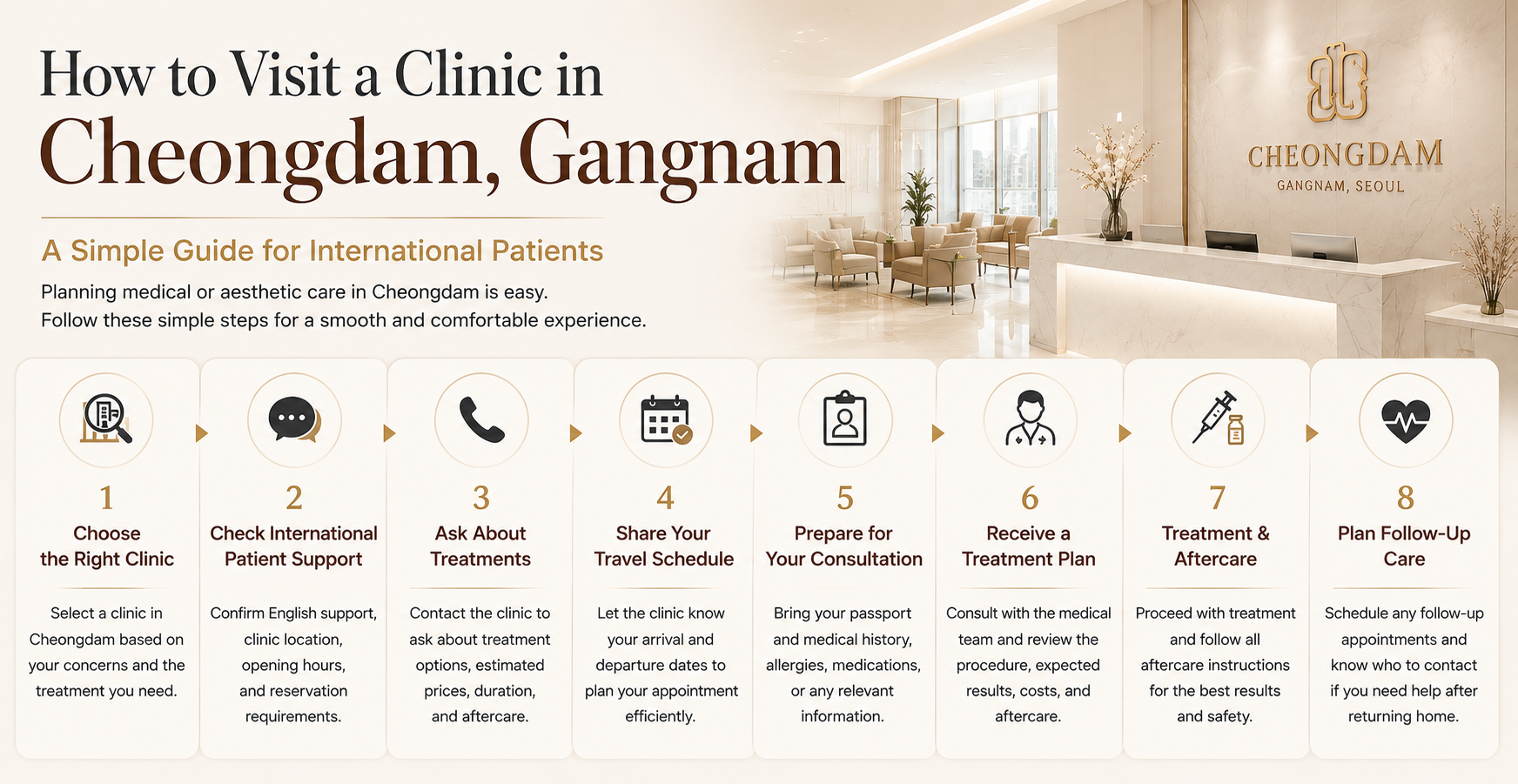
International patients considering lower eyelid surgery in Cheongdam should plan for consultation, surgery, recovery, and follow-up.
Before traveling to Seoul, prepare information about previous eye or facial procedures, medications, allergies, medical conditions, and any history of dry eyes or vision problems.
During consultation, ask about:
- English-language support or professional interpretation
- The surgeon performing the procedure
- Transconjunctival vs transcutaneous access
- Whether fat will be repositioned, removed, or supplemented
- Whether skin removal is necessary
- Expected swelling and bruising
- Follow-up appointments
- Emergency contact arrangements
- Recommended length of stay
- Timing of return flights
Patients should avoid scheduling an international flight based only on a generic recovery estimate. The operating team should provide individualized postoperative and travel guidance.
How Much Does Under Eye Fat Repositioning in Cheongdam Cost?
There is no universal price for under eye fat repositioning in Cheongdam.
The total cost may depend on:
- Surgical approach
- Extent of lower blepharoplasty
- Fat repositioning technique
- Whether skin is removed
- Anesthesia or sedation
- Surgeon and facility
- Preoperative evaluation
- Postoperative care
- Additional procedures
International patients should also account for accommodation, transportation, flights, medications, interpretation, and possible additional nights in Seoul.
When comparing quotations, ask for a detailed breakdown of what is included. Confirm whether anesthesia, facility fees, medications, follow-up visits, and postoperative care are part of the quoted price.
Questions to Ask Before Under Eye Fat Repositioning
Before choosing a provider in Cheongdam, consider asking:
- Am I a candidate for fat repositioning?
- Is my main concern fat protrusion, tear troughs, skin laxity, pigmentation, or something else?
- Will you use a transconjunctival or transcutaneous approach?
- Will any fat be removed?
- Will the orbital fat be repositioned to the tear trough?
- Do I need lower-eyelid skin removal?
- Do I have eyelid laxity?
- Could dry-eye symptoms be affected?
- What are the specific risks in my case?
- Who will perform the surgery?
- How long should I stay in Seoul?
- When can I fly home?
- What follow-up appointments are required?
- What happens if asymmetry or another complication develops?
- What is included in the total cost?
A thorough consultation should explain why a particular technique is appropriate for your anatomy rather than simply recommending the most popular procedure.
Conclusion
Under eye fat repositioning in Cheongdam can be considered for patients with lower-eyelid fat prominence, tear-trough deformity, and an uneven transition between the lower eyelid and cheek. The technique focuses on preserving and redistributing existing orbital fat rather than automatically removing it.
Modern lower blepharoplasty offers several approaches, and research does not support one universal technique for every patient. The appropriate treatment depends on fat distribution, skin laxity, eyelid support, facial anatomy, and the specific cause of the patient's under-eye concern.
For international patients, surgeon selection, surgical technique, communication, recovery planning, and postoperative follow-up should be evaluated alongside cost and location. Cheongdam can be a convenient Seoul destination for researching aesthetic surgery, but the individual surgeon and personalized treatment plan should remain the priority.
FAQs About Under Eye Fat Repositioning in Cheongdam
What is under eye fat repositioning?
Under eye fat repositioning is a lower blepharoplasty technique that moves existing orbital fat into adjacent hollows, such as the tear trough, rather than simply removing the fat.
Is under eye fat repositioning the same as fat grafting?
No. Fat repositioning uses existing orbital fat around the eye, while fat grafting harvests fat from another area of the body and transfers it to the face.
Can fat repositioning remove under-eye bags?
It can improve the appearance of bags caused by prominent orbital fat in selected patients. However, under-eye bags can have multiple contributing factors, including skin laxity and facial anatomy.
Does fat repositioning treat dark circles?
It may improve dark circles caused by structural shadows or tear-trough depressions, but it does not directly treat all forms of pigmentation or vascular discoloration.
Is transconjunctival or transcutaneous surgery better?
Neither approach is universally better. The appropriate approach depends on factors such as excess skin, fat distribution, eyelid anatomy, and the planned procedure.
What are the risks of under eye fat repositioning?
Potential risks include swelling, bruising, asymmetry, contour irregularities, dry eyes, infection, bleeding, lower-eyelid malposition, difficulty closing the eyes, and possible revision surgery. Rare vision complications can also occur with eyelid surgery.
How long does recovery take?
Early swelling and bruising generally improve progressively, but the timing varies between patients and procedures. Your surgeon should provide individualized instructions about exercise, makeup, follow-up, and travel.
Can foreigners have under eye fat repositioning in Cheongdam?
International patients can seek lower eyelid surgery in Seoul. Before booking, confirm language support, postoperative follow-up, emergency arrangements, and the recommended length of stay.
Can under eye fat repositioning be combined with other procedures?
Depending on the patient's anatomy, lower blepharoplasty may be combined with procedures such as skin treatment, facial fat grafting, or other facial rejuvenation procedures. Whether combining treatments is appropriate requires an individualized surgical assessment.