Titanium Cheongdam Seoul Clinic
Non-Surgical Lifting and Skin Tightening in Korea
Titanium Lifting in Cheongdam, Seoul is a non-surgical laser-based aesthetic treatment that simultaneously uses 755 nm, 810 nm, and 1064 nm wavelengths and may be considered for patients seeking improvement in facial firmness, mild laxity, contour, and overall skin appearance. Patients considering Titanium Lifting in Korea should receive an individualized consultation to determine appropriate treatment areas, energy settings, expected results, potential side effects, and whether laser lifting or another tightening treatment is better suited to their facial anatomy and concerns.
Titanium Lifting in Cheongdam, Seoul
Titanium Lifting is a non-invasive laser-based aesthetic treatment that has become increasingly associated with Korean facial lifting and skin-tightening procedures.
The treatment is performed using the Soprano Titanium platform and combines three laser wavelengths within a single applicator:
- 755 nm
- 810 nm
- 1064 nm
These wavelengths have different optical characteristics and interact with tissue at different depths.
Titanium treatment protocols use this combined energy profile with the goal of improving selected concerns involving facial firmness, mild laxity, contours, and overall skin appearance without surgical incisions.
What Is Titanium Lifting?
Titanium Lifting is a laser-based treatment rather than a surgical facelift, thread lift, HIFU procedure, or radiofrequency treatment.
The technology simultaneously delivers three wavelengths through one applicator while contact cooling helps manage the temperature of the skin surface.
Treatment protocols can be adjusted according to facial anatomy, skin condition, treatment area, and the desired aesthetic outcome.
The procedure is commonly discussed in Korea as a treatment for patients who want relatively low-downtime facial rejuvenation.
Is Titanium Lifting the Same as Soprano Titanium?
Soprano Titanium is the name of the Alma laser platform.
“Titanium Lifting” generally refers to an aesthetic treatment protocol performed using the Soprano Titanium system.
The platform was originally developed with triple-wavelength technology and is also widely associated with laser hair removal.
A lifting protocol therefore refers to a specific use and treatment methodology involving the platform rather than meaning that every Soprano Titanium procedure is a lifting treatment.
How Does Titanium Lifting Work?
Titanium Lifting simultaneously delivers 755 nm, 810 nm, and 1064 nm laser wavelengths.
Because each wavelength has different optical and penetration characteristics, their combined delivery creates a multi-depth energy profile.
Treatment protocols use controlled thermal energy with the aim of improving tissue firmness and facial appearance.
The exact biological and visible response depends on treatment settings, skin type, anatomy, treatment area, and individual response.
What Are the Three Titanium Wavelengths?
The Soprano Titanium platform combines three wavelengths in one applicator.
755 nm
The 755 nm wavelength has relatively greater interaction with superficial chromophores and contributes to the combined optical profile of the treatment.
810 nm
The 810 nm wavelength provides an intermediate component of the triple-wavelength system and contributes to energy delivery at different tissue levels.
1064 nm
The longer 1064 nm wavelength has deeper penetration characteristics and forms part of the multi-depth treatment profile.
The three wavelengths are delivered together rather than simply performing three unrelated laser procedures one after another.
What Can Titanium Lifting Treat?
Depending on the patient and treatment protocol, Titanium Lifting may be considered for concerns involving:
- Mild facial skin laxity
- Reduced skin firmness
- Early jowling
- Lower-face contours
- Jawline definition
- Dull-looking skin
- Uneven-looking skin tone
- Early signs of facial aging
Titanium is not appropriate for every cause of facial sagging or contour change.
An individualized assessment should determine whether the concern originates primarily from skin laxity, facial fat, volume loss, muscle anatomy, bone structure, or another factor.
Titanium Lifting for Facial Firmness
Loss of facial firmness develops gradually as skin and underlying facial tissues change with age.
Titanium Lifting may be considered for patients seeking non-surgical improvement in mild firmness concerns.
The treatment does not physically remove excess skin or surgically reposition deeper facial tissues.
Patients with substantial facial laxity should therefore have realistic expectations about what a non-invasive laser treatment can achieve.
Titanium Lifting for the Jawline
Jawline definition is influenced by multiple anatomical factors, including skin firmness, subcutaneous fat, facial muscles, chin projection, and skeletal structure.
Titanium Lifting may be considered when mild tissue laxity contributes to reduced lower-face definition.
However, it cannot reshape the jawbone or correct every cause of an undefined jawline.
Patients with significant submental fat, muscle-related concerns, or skeletal factors may require a different treatment approach.
Titanium Lifting for the Lower Face
The lower face is a common area considered for non-surgical tightening treatments.
Titanium may be used in selected patients seeking improvement in mild softness, early jowling, or reduced facial definition.
Treatment should be planned according to facial volume and tissue distribution.
Aggressive treatment is not automatically appropriate for every patient, particularly when facial volume loss is already contributing to an aged appearance.
Titanium Lifting for the Neck
Selected Titanium protocols may include appropriate areas of the neck.
Neck appearance can be affected by skin laxity, wrinkles, subcutaneous fat, muscle activity, sun damage, and natural anatomy.
Laser treatment may address selected skin-quality or firmness concerns but cannot correct every cause of neck aging.
Patients with substantial excess skin or prominent platysmal bands may require other treatment options.
Does Titanium Lifting Brighten the Skin?
Titanium Lifting is also commonly associated with improvement in overall skin appearance and brightness.
Because the system includes wavelengths with different interactions with skin chromophores, patients may notice changes in the appearance of skin tone following treatment.
However, Titanium should not automatically be considered a treatment for every pigmentation disorder.
Melasma, post-inflammatory pigmentation, lentigines, and other pigmentary conditions require appropriate diagnosis because laser and light treatments can affect different pigmentation conditions differently.
Does Titanium Lifting Slim the Face?
Titanium Lifting is sometimes marketed in Korea using terms such as facial slimming or contouring.
These terms should be interpreted carefully.
The treatment may improve the appearance of facial contours in selected patients, but it is not designed to reshape facial bones or produce substantial surgical fat removal.
If facial fullness is primarily caused by subcutaneous fat or masseter muscle size, another treatment may be more appropriate.
Is Titanium a Laser, HIFU, or RF Treatment?
Titanium Lifting is a laser-based treatment.
It is different from HIFU treatments such as Shurink or Ultherapy and radiofrequency treatments such as Thermage or Oligio.
Although all of these treatments may appear in the broad category of non-surgical facial tightening, they deliver energy using different physical mechanisms and target tissues differently.
Titanium vs. Thermage
Titanium and Thermage use different energy technologies.
Titanium uses multiple laser wavelengths, while Thermage uses monopolar radiofrequency.
Thermage is primarily associated with controlled RF heating for tissue tightening, while Titanium uses a triple-wavelength laser platform and may be selected for a combination of firmness, contour, and skin-appearance goals.
Neither treatment should automatically be considered better for every patient.
Titanium vs. Ultherapy
Titanium and Ultherapy are fundamentally different energy-based treatments.
Titanium uses laser energy, while Ultherapy uses microfocused ultrasound.
Ultrasound can focus energy at predetermined tissue depths, whereas Titanium uses simultaneous laser wavelengths with different penetration and absorption characteristics.
Treatment selection depends on facial anatomy, skin condition, degree of laxity, treatment goals, previous procedures, and tolerance for discomfort.
Titanium vs. Shurink
Titanium uses triple-wavelength laser technology, while Shurink uses focused ultrasound.
Both may be marketed for non-surgical lifting in Korea, but their energy delivery and treatment characteristics differ.
Patients should not assume that the same number of sessions, treatment areas, or expected outcomes apply to both technologies.
Titanium vs. Oligio
Titanium is laser-based, while Oligio uses monopolar radiofrequency.
Oligio is primarily intended to generate controlled RF heating, whereas Titanium uses three simultaneous laser wavelengths.
The appropriate choice depends on whether the treatment priority involves skin firmness, facial contours, overall skin appearance, degree of laxity, or a combination of concerns.
Titanium vs. Thread Lift
Titanium Lifting does not insert threads beneath the skin.
A thread lift involves placing absorbable or other medical threads within tissue to create mechanical support or repositioning effects.
Titanium is performed externally using laser energy.
The procedures therefore differ substantially in invasiveness, mechanism, downtime, risks, and expected results.
Titanium vs. Surgical Facelift
Titanium Lifting cannot reproduce the structural correction achieved through facelift surgery.
A surgical facelift can reposition deeper tissues and remove excess skin.
Titanium may instead be considered by patients with relatively mild concerns who prefer a non-surgical treatment and accept a more modest degree of improvement.
The term “lifting” should therefore not be interpreted as meaning that laser treatment and surgical lifting are equivalent.
Is Titanium Lifting Painful?
Treatment comfort varies according to individual sensitivity, energy settings, treatment area, and protocol.
Soprano Titanium incorporates continuous contact cooling designed to help manage skin-surface temperature during energy delivery.
Patients may experience warmth, tingling, or temporary discomfort.
Unexpected or excessive pain should be reported during treatment.
Is There Downtime After Titanium Lifting?
Titanium is generally selected as a relatively low-downtime aesthetic procedure.
Temporary reactions can include:
- Redness
- Warmth
- Mild swelling
- Sensitivity
- Temporary discomfort
The severity and duration vary between patients.
Patients should follow the aftercare recommendations provided by their healthcare professional.
When Will I See Titanium Lifting Results?
Some patients may notice changes in facial appearance relatively soon after treatment.
Additional changes may develop as treated tissues respond over time.
The timing and degree of improvement vary according to treatment protocol, baseline skin condition, facial anatomy, age, and individual biological response.
Immediate post-treatment appearance should not be interpreted as a guaranteed final result.
How Long Does Titanium Lifting Last?
There is no single duration that applies to every patient.
The persistence of visible improvement depends on age, skin condition, treatment intensity, number of treatments, lifestyle, sun exposure, natural aging, and individual response.
Maintenance treatment may be considered according to clinical assessment.
Permanent lifting should not be promised.
How Many Titanium Treatments Do I Need?
Treatment frequency should be individualized.
Some Korean treatment protocols recommend a series of sessions separated by several weeks, while other patients may follow a different schedule according to their concerns and response.
The appropriate number of sessions depends on:
- Skin condition
- Facial anatomy
- Treatment area
- Degree of laxity
- Energy delivered
- Previous aesthetic treatments
- Individual treatment goals
A fixed treatment package should not replace an individualized assessment.
What Does kJ Mean in Titanium Lifting?
Titanium treatments in Korea are frequently advertised according to the total amount of energy delivered, expressed in kilojoules (kJ).
Patients may therefore encounter packages such as 40 kJ, 60 kJ, or 80 kJ.
A higher kJ number does not automatically mean a better treatment.
Facial size, treatment area, energy distribution, technique, skin condition, and treatment goals all matter when determining an appropriate protocol.
What Are the Possible Side Effects of Titanium Lifting?
Possible temporary reactions can include redness, warmth, swelling, tenderness, sensitivity, or discomfort.
As with other laser and energy-based treatments, inappropriate treatment settings or patient selection can increase the risk of complications such as:
- Burns
- Blistering
- Pigmentation changes
- Prolonged redness
- Unexpected tissue or contour changes
The specific risks should be discussed according to the treatment protocol, skin type, medical history, and treatment area.
Who May Not Be Suitable for Titanium Lifting?
Titanium Lifting is not appropriate for every patient.
Suitability can depend on active skin conditions, infection, pregnancy, medications, photosensitivity, medical conditions, recent aesthetic procedures, and other individual factors.
Patients with a history of pigmentation problems or previous adverse reactions to laser treatment should inform their healthcare professional.
Eligibility should be determined after an individualized medical and skin assessment.
Can Titanium Be Combined With Other Lifting Treatments?
Titanium may be incorporated into a broader aesthetic treatment plan.
Depending on the patient, other procedures may target deeper laxity, muscle activity, facial volume, skin texture, or pigmentation.
Possible treatment plans may include RF, HIFU, botulinum toxin, fillers, or skin-quality treatments.
However, combining multiple procedures is not automatically superior.
Treatment sequence and timing should be determined according to facial anatomy, skin condition, and the interaction between procedures.
Titanium Lifting for Foreigners in Seoul, Korea
International residents, expatriates, students, business travelers, and visitors may seek Titanium Lifting while living in or traveling to Seoul.
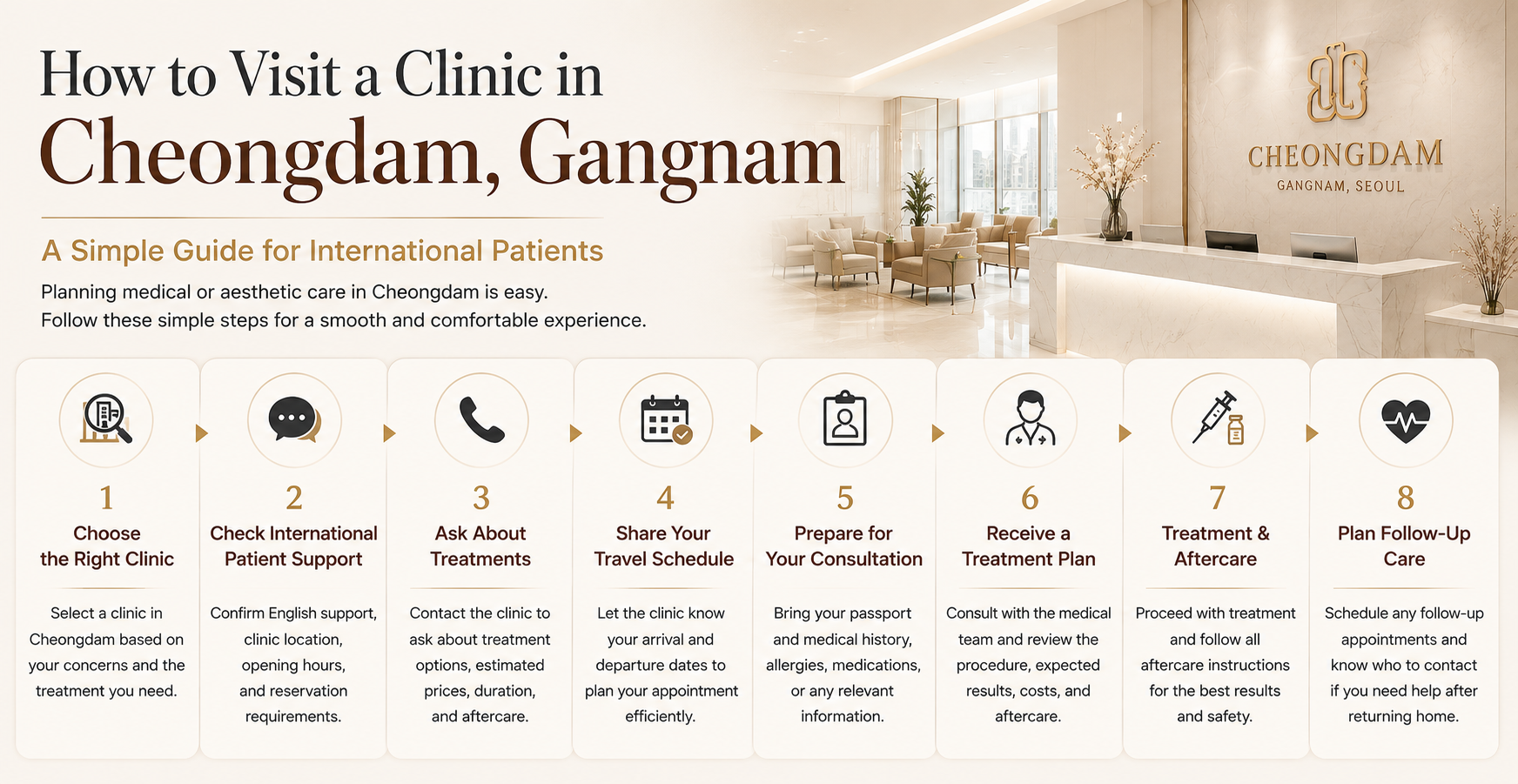
Foreign patients considering Titanium in Cheongdam or Gangnam may wish to confirm whether English-language consultation is available and ask about the exact Soprano Titanium system, treatment areas, total energy in kJ, treatment technique, expected results, discomfort, downtime, pricing, and follow-up care.
Patients should also disclose previous Thermage, Oligio, Ultherapy, Shurink, fillers, botulinum toxin, thread lifting, lasers, and facial surgery.
Choosing a Titanium Lifting Clinic in Cheongdam
Patients considering Titanium Lifting should look beyond promotional pricing or total kJ alone.
Important considerations include the authenticity of the Soprano Titanium platform, healthcare professional experience, appropriate assessment of facial anatomy, individualized energy delivery, treatment areas, realistic expectations, safety protocols, and follow-up care.
A consultation should also determine whether the primary concern is skin laxity, facial fat, volume loss, pigmentation, muscle activity, or another anatomical factor.
The largest energy number on a price list is, tragically, not a substitute for understanding the face attached to it.
Frequently Asked Questions
What is Titanium Lifting?
Titanium Lifting is a non-surgical laser-based aesthetic treatment commonly performed using the Soprano Titanium platform and simultaneous 755 nm, 810 nm, and 1064 nm wavelengths.
Is Titanium Lifting a laser treatment?
Yes. Titanium uses laser energy and should not be confused with radiofrequency or HIFU treatments.
What wavelengths does Titanium Lifting use?
The Soprano Titanium platform combines 755 nm, 810 nm, and 1064 nm wavelengths within one applicator.
Is Titanium the same as Soprano Titanium?
Soprano Titanium is the device platform. Titanium Lifting generally refers to a facial aesthetic treatment protocol performed using that platform.
Does Titanium Lifting tighten sagging skin?
Titanium may improve the appearance of mild facial laxity and reduced firmness in selected patients. It cannot reproduce the degree of tissue repositioning achieved with surgery.
Can Titanium improve the jawline?
Titanium may improve lower-face firmness and contour appearance when mild laxity contributes to reduced jawline definition. Bone structure, fat, and muscle anatomy can also affect the jawline.
Does Titanium Lifting brighten skin?
Titanium treatment may be associated with improvement in overall skin appearance and brightness in selected patients, but it should not be considered a universal treatment for pigmentation disorders.
Is Titanium the same as Thermage?
No. Titanium uses laser energy, while Thermage uses monopolar radiofrequency.
Is Titanium the same as Ultherapy or Shurink?
No. Ultherapy and Shurink use focused ultrasound, while Titanium uses a triple-wavelength laser platform.
How much energy is used for Titanium Lifting?
Titanium treatments are frequently described in kilojoules, or kJ. The appropriate total energy depends on treatment area, facial anatomy, skin condition, and treatment plan rather than a universal number.
Is Titanium Lifting painful?
Soprano Titanium uses contact cooling to support treatment comfort. Patients may still experience warmth, tingling, or temporary discomfort.
Is there downtime after Titanium Lifting?
Downtime is generally limited, although temporary redness, warmth, swelling, or sensitivity may occur.
How many Titanium treatments are needed?
The appropriate number varies according to skin condition, treatment goals, protocol, and individual response. Some protocols involve multiple treatments separated by several weeks.
Can foreigners get Titanium Lifting in Korea?
Yes. International residents and visitors can seek Titanium Lifting at Korean medical institutions. Treatment protocols, pricing, English-language assistance, device availability, and follow-up care vary between clinics.
Where can I get Titanium Lifting in Cheongdam, Seoul?
Patients considering Titanium Lifting can consult qualified aesthetic medical professionals in Cheongdam and the surrounding Gangnam area. An individualized assessment can determine whether triple-wavelength laser treatment is appropriate for the patient’s facial anatomy, skin condition, and treatment goals.
Titanium Lifting Consultation in Cheongdam, Seoul
Titanium Lifting may be considered by patients seeking a non-surgical laser-based approach to mild facial laxity, skin firmness, facial contours, and overall skin appearance.
Patients searching for
Titanium Cheongdam,
Titanium Lifting Seoul,
Soprano Titanium Korea,
Laser Lifting Gangnam,
Non-Surgical Face Lifting Seoul, or
Titanium Lifting for Foreigners in Korea can consult a qualified healthcare professional to discuss appropriate treatment areas, energy settings, realistic results, potential risks, and individualized treatment planning.