Laser Toning Cheongdam Seoul Clinic
Skin Brightening and Pigmentation Laser Treatment in Korea
Laser toning in Cheongdam, Seoul is a low-fluence laser treatment approach commonly used for selected pigmentation concerns such as uneven skin tone and melasma, often using 1064 nm Q-switched Nd or other pigment-targeting laser systems. Patients considering laser toning in Korea should receive an individualized skin assessment to identify the type and depth of pigmentation, appropriate laser and wavelength, number of sessions, expected improvement, recurrence risk, and possibility of post-inflammatory pigment changes.
Laser Toning Treatment in Cheongdam, Seoul
Laser toning is a commonly performed pigmentation and skin-tone treatment in Korean aesthetic and dermatology clinics.
Rather than referring to one specific device, laser toning describes a treatment technique in which pigment-targeting laser energy is delivered using selected parameters over the skin.
Low-fluence 1064 nm Q-switched Nd treatment is particularly associated with conventional laser toning for melasma and diffuse facial pigmentation.
Modern clinics may also use picosecond lasers or other pigment-focused systems in treatment plans described broadly as toning.
The appropriate technology depends on the patient's diagnosis, skin type, pigmentation depth, and previous treatment history.
What Is Laser Toning?
Laser toning is a non-ablative laser treatment approach commonly used for facial pigmentation and uneven skin tone.
Traditional laser toning frequently uses a 1064 nm Q-switched Nd laser at relatively low fluence.
Rather than aggressively destroying visible pigment in a single session, treatment is generally performed conservatively and may be repeated over multiple sessions.
This approach has become particularly common in Korea and other Asian countries for patients concerned about melasma and diffuse pigmentation.
How Does Laser Toning Work?
Laser energy interacts with melanin-containing structures within the skin.
Depending on the wavelength and treatment parameters, this can disrupt or reduce targeted pigment while attempting to limit excessive injury to surrounding tissue.
The fragmented or altered pigment is gradually processed through biological mechanisms.
Treatment parameters must be carefully selected because excessive laser exposure can cause inflammation, hyperpigmentation, or unwanted loss of pigment.
What Laser Is Used for Laser Toning?
Laser toning does not refer to one brand.
A clinic may use technologies such as:
- Q-switched Nd laser
- 1064 nm laser toning
- Picosecond Nd laser
- Other picosecond pigment lasers
- Dual-wavelength pigment platforms
The exact wavelength, pulse duration, fluence, spot size, and treatment protocol vary between devices.
Patients should therefore ask which actual laser is being used rather than simply booking something labeled “toning.”
What Does 1064 nm Laser Toning Mean?
1064 nm is a wavelength commonly produced by Nd lasers.
It penetrates relatively deeply into the skin and has lower melanin absorption than shorter visible wavelengths.
Low-fluence 1064 nm Q-switched Nd treatment has been widely used for melasma and diffuse pigmentation, particularly in Asian skin.
However, repeated treatment requires careful monitoring because excessive cumulative exposure can produce unwanted pigmentary changes.
What Can Laser Toning Treat?
Depending on diagnosis and laser selection, laser toning may be considered for concerns involving:
- Melasma
- Uneven skin tone
- Diffuse facial pigmentation
- Selected post-inflammatory pigmentation
- Sun-related pigmentation
- Dull-looking complexion
- Selected superficial pigmented lesions
Not every brown mark should receive the same laser protocol.
Pigment diagnosis is important before treatment.
Laser Toning for Melasma
Melasma is one of the conditions most commonly associated with laser toning.
It is a chronic and recurrent pigmentary disorder influenced by multiple factors, including ultraviolet exposure, visible light, hormones, genetics, and inflammation.
Low-fluence laser toning may improve visible pigmentation in selected patients.
However, laser treatment does not eliminate the biological tendency toward melasma.
Recurrence is common.
Management may also involve sun protection, topical medication, skincare, and control of triggering factors.
Can Laser Toning Cure Melasma?
Laser toning should not be described as a permanent cure for melasma.
Melasma frequently recurs even after visible improvement.
Overly aggressive or repeated laser treatment may also cause complications.
The goal is generally controlled improvement and long-term management rather than permanent eradication.
Laser Toning for Hyperpigmentation
Hyperpigmentation means that an area of skin contains increased visible pigment.
This can result from several different conditions.
Laser toning may be considered for selected pigmentation, but treatment depends on whether the pigment represents melasma, post-inflammatory hyperpigmentation, freckles, lentigines, dermal pigmentation, or another condition.
Diagnosis matters because these conditions behave differently.
Laser Toning for Post-Inflammatory Hyperpigmentation
Post-inflammatory hyperpigmentation, or PIH, can develop after acne, dermatitis, burns, procedures, or other inflammation.
Laser treatment may be considered in selected cases.
However, because lasers themselves create a controlled tissue response, excessive treatment can trigger additional PIH.
Patients with a history of pigment changes after procedures should disclose this before treatment.
Laser Toning for Acne Marks
Flat brown or gray marks left after acne may represent post-inflammatory hyperpigmentation.
Laser toning may help selected pigmentary acne marks.
However, it does not directly correct all acne scars.
Indented rolling, boxcar, and ice-pick scars are structural changes and may require RF microneedling, fractional laser, subcision, TCA CROSS, or other treatments.
Pigment and scars have once again committed the inconvenience of being different biological problems despite occupying the same square centimeter of face.
Laser Toning for Freckles
Freckles are superficial pigmented lesions influenced by genetics and sun exposure.
Some pigment lasers can reduce freckles effectively.
However, conventional low-fluence laser toning may not always be the most efficient treatment for discrete freckles.
A healthcare professional may recommend another wavelength or treatment mode depending on the lesions and skin type.
Laser Toning for Sunspots
Solar lentigines are discrete pigmented lesions associated with cumulative ultraviolet exposure.
Targeted pigment laser treatment may be more appropriate than generalized toning in some patients.
Any suspicious, changing, irregular, or bleeding pigmented lesion should be medically assessed before cosmetic laser treatment.
Laser Toning for Uneven Skin Tone
Diffuse pigmentation can make skin tone appear uneven.
Laser toning may gradually reduce selected excess pigmentation and create a more even-looking complexion.
The realistic goal is improvement in abnormal or unwanted pigmentation.
Laser treatment does not change a person's natural baseline skin color into a fundamentally different skin tone.
Does Laser Toning Brighten Skin?
Laser toning is often marketed as a “skin brightening” treatment.
In medical terms, this generally refers to reducing selected excess pigmentation and improving uneven tone.
It should not imply bleaching healthy skin or changing ethnicity-associated natural pigmentation.
A brighter appearance can result when unwanted pigmentation becomes less visible and skin tone appears more uniform.
Laser Toning vs. Skin Whitening
Laser toning and skin whitening should not automatically be treated as equivalent concepts.
Laser toning targets selected pigmentation.
The goal should be management of pigmentary concerns and uneven tone rather than indiscriminate reduction of normal melanin.
Melanin performs important biological functions, including protection from ultraviolet radiation.
Laser Toning vs. Pico Toning
Traditional laser toning commonly uses nanosecond Q-switched Nd technology.
Pico toning uses picosecond-duration laser pulses.
Picosecond systems deliver energy over a much shorter pulse duration and can produce stronger photomechanical effects.
Both may be used for selected pigmentation concerns, but they are not identical treatments.
Laser Toning vs. PicoSure
PicoSure is a specific picosecond laser platform centered on 755 nm Alexandrite technology.
Conventional laser toning is commonly associated with low-fluence 1064 nm Q-switched Nd treatment.
Their wavelengths, pulse durations, tissue interactions, and treatment protocols differ.
The appropriate option depends on the type and depth of pigmentation.
Laser Toning vs. PicoWay
PicoWay is a picosecond laser platform offering multiple wavelengths.
Traditional laser toning generally refers to a low-fluence Q-switched treatment strategy.
PicoWay may be used in picosecond pigment protocols, but the device name alone does not determine which treatment is appropriate.
Laser Toning vs. IPL
IPL stands for intense pulsed light.
It is not a laser.
IPL emits a broad spectrum of light and can target selected pigment and vascular concerns using filters.
Laser toning uses a specific laser wavelength.
IPL may be useful when pigmentation and vascular redness coexist, while laser toning may be selected for different pigmentary patterns.
Laser Toning vs. Fraxel
Laser toning primarily targets pigmentation with non-ablative pigment-focused energy.
Fraxel refers to fractional laser resurfacing systems that create microscopic treatment zones for skin remodeling.
Fractional treatment may be selected when texture, scars, or photoaging are major concerns.
The treatments therefore have different primary purposes.
Laser Toning vs. Genesis Laser
Laser Genesis generally uses a longer-pulse 1064 nm Nd approach for selected redness, texture, and skin-rejuvenation concerns.
Laser toning commonly uses shorter Q-switched pulses at lower fluence for pigmentation.
Even when two treatments use the same nominal wavelength, pulse duration and treatment parameters can produce substantially different tissue effects.
Laser Toning vs. Chemical Peel
Chemical peels use chemical agents to produce controlled exfoliation or injury at selected skin depths.
Laser toning uses light energy to interact with pigment.
Both may improve selected pigmentation concerns, but they have different mechanisms and risk profiles.
Treatment selection should consider skin sensitivity, pigment type, downtime, and previous reactions.
Does Laser Toning Improve Pores?
Laser toning is primarily a pigment-focused treatment.
Some patients may notice general improvements in skin appearance, but enlarged-looking pores are influenced by sebum, genetics, acne, and skin elasticity.
RF microneedling, fractional lasers, or other texture-focused treatments may be more appropriate when pores are the primary concern.
Does Laser Toning Improve Acne Scars?
Conventional laser toning is not primarily an acne-scar remodeling treatment.
It may improve pigmentation left by acne, but structural scars generally require treatments that produce more substantial dermal remodeling.
The distinction between acne marks and acne scars should be made during consultation.
Does Laser Toning Stimulate Collagen?
Some laser exposure can influence cellular and tissue responses, but collagen stimulation is not the primary reason conventional low-fluence pigment toning is performed.
Patients primarily seeking tightening or scar remodeling may benefit from another treatment modality.
Marketing every aesthetic device as a collagen machine eventually makes the word “collagen” about as informative as “premium.”
Is Laser Toning Safe for Asian Skin?
Laser toning has been widely used in Asian patients and was developed partly in response to the challenges of treating pigment-prone skin.
However, Asian skin can develop post-inflammatory hyperpigmentation or hypopigmentation following laser treatment.
Appropriate wavelength selection, conservative energy settings, treatment intervals, sun protection, and monitoring remain important.
No laser is automatically risk-free because the patient happens to be an appropriate skin type.
Can Laser Toning Cause Hyperpigmentation?
Yes.
Excessive inflammation after laser treatment can cause post-inflammatory hyperpigmentation.
Patients with melasma may also experience rebound pigmentation or worsening following inappropriate treatment.
Risk depends on skin type, diagnosis, treatment settings, sun exposure, and individual response.
Can Laser Toning Cause Hypopigmentation?
Yes.
Repeated low-fluence laser toning has been associated with mottled or confetti-like hypopigmentation in some patients.
This complication is particularly important when numerous treatments are performed over a prolonged period.
Treatment frequency and cumulative exposure should therefore be monitored rather than assuming that low-energy treatment can be repeated indefinitely without consequence.
What Is Mottled Hypopigmentation?
Mottled hypopigmentation refers to patchy areas of reduced skin pigmentation.
It has been reported following repeated low-fluence Q-switched Nd laser toning.
The condition can be difficult to treat.
Patients undergoing repeated laser-toning sessions should be monitored for early signs of uneven lightening.
Is Laser Toning Painful?
Laser toning is generally associated with relatively mild treatment sensation.
Patients may experience warmth, light snapping, prickling, or tingling.
Comfort varies according to the device, treatment parameters, area, and individual sensitivity.
Topical anesthetic is not always necessary for low-fluence treatment but may be considered depending on the protocol.
Is There Downtime After Laser Toning?
Conventional low-fluence laser toning generally involves limited visible downtime.
Temporary effects may include:
- Mild redness
- Warmth
- Dryness
- Temporary sensitivity
- Mild swelling
- Temporary darkening of selected pigment
Patients can often return to normal daily activities relatively quickly.
More intensive pigment treatments may involve greater recovery.
When Will I See Laser Toning Results?
Laser toning is often performed gradually rather than as a single aggressive treatment.
Some patients may notice improvement after several sessions.
The timing depends on the pigmentation diagnosis, treatment settings, skin type, and individual response.
Melasma in particular should be evaluated over time because short-term clearing does not necessarily predict long-term control.
How Many Laser Toning Sessions Do I Need?
There is no universal number.
A series of treatments is commonly used for low-fluence laser toning.
The appropriate number depends on:
- Pigmentation diagnosis
- Pigment depth
- Skin type
- Laser device
- Wavelength
- Treatment parameters
- Previous treatments
- Individual response
Repeated treatment should be reassessed periodically rather than continued automatically.
How Often Can Laser Toning Be Done?
Treatment intervals vary according to the device, parameters, diagnosis, and skin response.
Because cumulative treatment can contribute to complications such as hypopigmentation, frequency should be determined clinically.
More frequent treatment is not automatically more effective.
How Long Do Laser Toning Results Last?
Duration depends on the pigmentation condition.
Sun-related lesions may remain improved but new pigmentation can develop.
Melasma frequently recurs because it is a chronic condition.
Consistent sun protection and maintenance skincare can therefore be important even after successful treatment.
What Are the Side Effects of Laser Toning?
Potential temporary reactions include redness, warmth, dryness, sensitivity, and temporary pigment darkening.
Less common complications can include:
- Post-inflammatory hyperpigmentation
- Rebound pigmentation
- Hypopigmentation
- Mottled hypopigmentation
- Blistering
- Burns
- Infection
- Scarring
- Prolonged redness
Risk depends on diagnosis, device, treatment parameters, cumulative exposure, and individual skin response.
Who May Not Be Suitable for Laser Toning?
Treatment may need to be postponed or modified for patients with:
- Active skin infection
- Significant active dermatitis
- Recent substantial sun exposure
- Certain photosensitizing medications
- Pregnancy
- History of abnormal scarring
- Previous laser-related pigment complications
- Unexplained or suspicious pigmented lesions
Medical and skin history should be reviewed before treatment.
Laser Toning Aftercare
After treatment, patients should follow the clinic's specific instructions.
General aftercare commonly emphasizes:
- Gentle cleansing
- Moisturizing
- Broad-spectrum sunscreen
- Avoiding unnecessary sun exposure
- Avoiding aggressive exfoliation
- Temporarily reducing irritating skincare if necessary
Sun protection is particularly important when treating melasma and other pigmentary conditions.
Can Laser Toning Be Combined With Other Treatments?
Laser toning may form part of a broader pigmentation-management plan.
Depending on diagnosis, treatment may be combined or alternated with topical medications, chemical peels, picosecond lasers, vascular treatments, skin-rejuvenation procedures, or other approaches.
Treatment timing should be planned carefully to minimize unnecessary inflammation.
A pigmentation plan does not become more sophisticated merely because every machine in the clinic receives a turn.
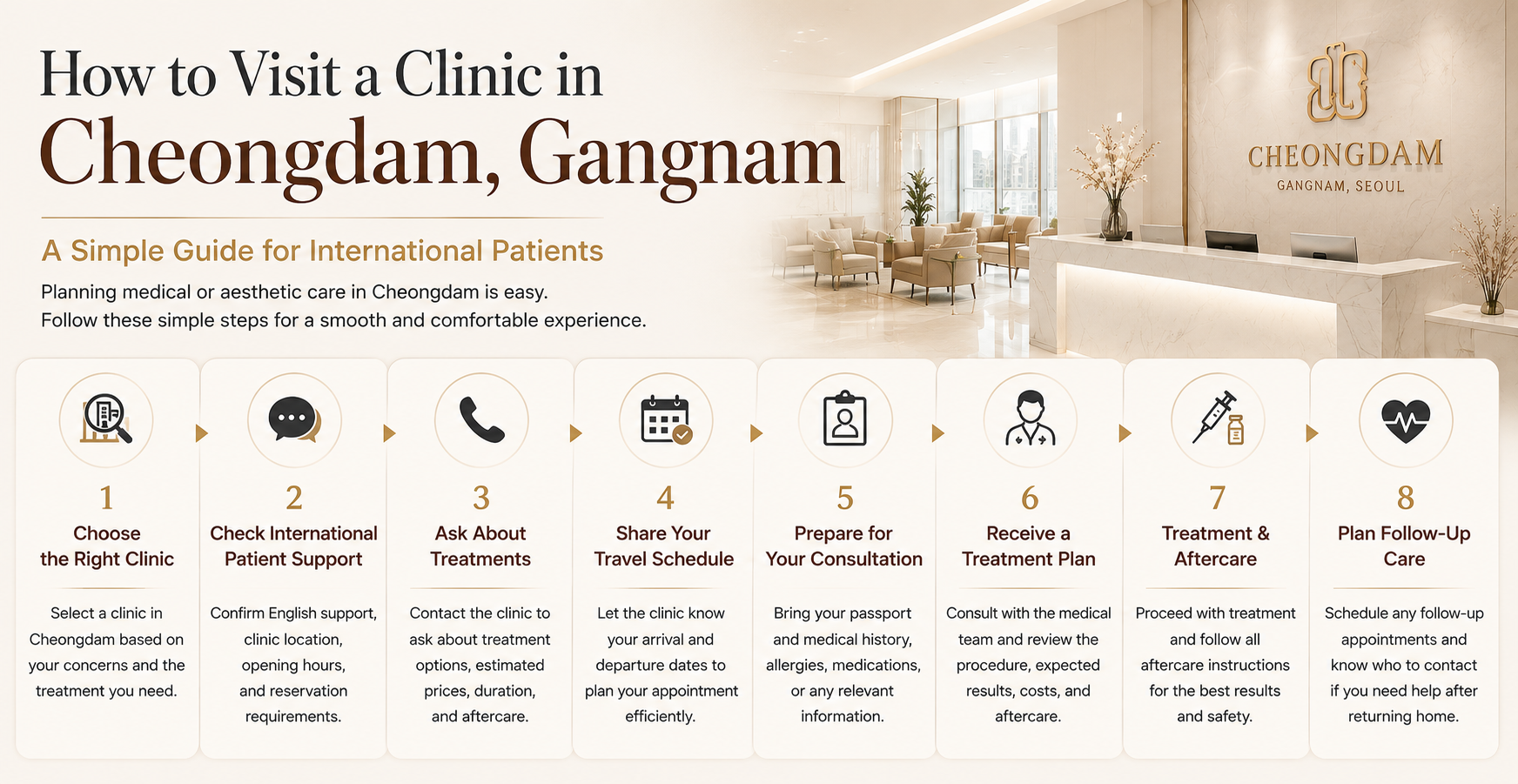
Laser Toning for Foreigners in Seoul, Korea
International residents, expatriates, students, business travelers, and visitors may seek laser toning while living in or traveling to Seoul.
Foreign patients considering laser toning in Cheongdam or Gangnam may wish to confirm whether English-language consultation is available and ask about:
- The exact laser device
- Wavelength
- Q-switched or picosecond technology
- Pigmentation diagnosis
- Treatment parameters
- Number and interval of sessions
- Expected downtime
- PIH and hypopigmentation risk
- Pricing
- Follow-up care
Patients should also disclose previous laser treatments, melasma, history of PIH, recent tanning or sun exposure, and relevant medications.
Choosing a Laser Toning Clinic in Cheongdam
Patients should look beyond package prices or promises of dramatically brighter skin.
Important considerations include accurate pigmentation diagnosis, an authentic and appropriate laser system, healthcare professional experience with Asian and pigment-prone skin, individualized energy settings, monitoring of cumulative treatments, realistic expectations, and appropriate aftercare.
The clinic should also be willing to modify or stop repeated treatment if the skin begins showing signs of unwanted pigment loss.
Frequently Asked Questions
What is laser toning?
Laser toning is a treatment approach using pigment-targeting laser energy, commonly low-fluence 1064 nm Q-switched Nd, for selected facial pigmentation and uneven skin tone concerns.
Is laser toning a specific laser?
No. Laser toning describes a treatment technique rather than one specific brand or device.
What wavelength is used for laser toning?
Traditional laser toning commonly uses 1064 nm Q-switched Nd energy, although other laser technologies may also be used in toning protocols.
Does laser toning brighten skin?
Laser toning may create a brighter and more even-looking complexion by reducing selected unwanted pigmentation. It should not be expected to change natural baseline skin color.
Is laser toning good for melasma?
Low-fluence laser toning may improve melasma in selected patients, but melasma is chronic and recurrence is common.
Can laser toning permanently cure melasma?
No. Melasma can recur after successful treatment and generally requires long-term management.
Does laser toning remove freckles?
Selected pigment lasers can reduce freckles, although a targeted pigment protocol may sometimes be more appropriate than generalized low-fluence toning.
Does laser toning treat acne scars?
Laser toning may improve pigmented acne marks but is not primarily a treatment for structural atrophic acne scars.
What is the difference between laser toning and pico toning?
Traditional laser toning commonly uses nanosecond Q-switched energy, while pico toning uses much shorter picosecond pulses.
Is laser toning the same as PicoSure?
No. PicoSure is a specific picosecond laser platform, while laser toning is a broader treatment technique.
Is laser toning safe for Asian skin?
It can be used in Asian and pigment-prone skin, but PIH, rebound pigmentation, and hypopigmentation remain possible.
Can laser toning cause white spots?
Repeated low-fluence laser toning has been associated with mottled or confetti-like hypopigmentation in some patients.
Is laser toning painful?
Treatment sensation is generally mild and may feel like warmth, light snapping, or prickling.
Is there downtime after laser toning?
Low-fluence laser toning generally involves limited downtime, although temporary redness, warmth, dryness, or sensitivity may occur.
How many laser toning sessions are needed?
A series is commonly performed, but the appropriate number and interval depend on diagnosis, laser parameters, skin type, and treatment response.
Can foreigners get laser toning in Korea?
Yes. International residents and visitors can receive laser toning at medical institutions in Korea. Devices, protocols, pricing, English-language assistance, and follow-up care vary by clinic.
Where can I get laser toning in Cheongdam, Seoul?
Patients considering laser toning can consult qualified medical professionals in Cheongdam and the surrounding Gangnam area. A skin assessment should determine the pigmentation diagnosis and appropriate laser, wavelength, treatment settings, and treatment interval.
Laser Toning Consultation in Cheongdam, Seoul
Laser toning may be considered by patients seeking treatment for selected melasma, diffuse pigmentation, post-inflammatory pigmentation, uneven skin tone, and dull-looking complexion.
Patients searching for
Laser Toning Cheongdam,
Laser Toning Seoul,
Pigmentation Laser Korea,
Skin Brightening Gangnam,
Melasma Laser Seoul,
1064 nm Laser Toning Korea, or
Laser Toning for Foreigners in Seoul can consult a qualified healthcare professional to discuss the pigmentation diagnosis, appropriate laser technology, expected results, potential risks, treatment frequency, and individualized treatment plan.