Facial Fat Grafting in Cheongdam
Facial Fat Grafting in Cheongdam
Facial fat grafting in Cheongdam is a surgical cosmetic procedure that uses a patient's own fat to restore or add volume to selected areas of the face. It may be considered for age-related volume loss, hollow areas, facial contour concerns, or certain asymmetries.
Unlike dermal fillers, facial fat grafting requires fat to be harvested from another part of the body before it is processed and transferred into the face. Because some of the transplanted fat may be absorbed during healing, the final amount of retained volume can vary between individuals. A systematic review found substantial variation in reported retention rates, highlighting the unpredictable nature of long-term volume retention.
For international patients researching facial fat grafting in Seoul, the decision should involve more than comparing treatment prices or looking at photographs. Facial anatomy, injection technique, donor-site selection, surgical safety, recovery, and postoperative follow-up all deserve careful consideration.
What Is Facial Fat Grafting?
Facial fat grafting, also called facial fat transfer or autologous fat grafting, involves taking fat from one part of the patient's body and transferring it to another area.
The procedure generally includes three stages:
- Fat harvesting from a suitable donor area
- Processing and preparation of the harvested fat
- Injection of small amounts of fat into selected facial areas
The transferred fat can be used to create or restore soft-tissue volume. The objective is usually to achieve a balanced improvement rather than simply adding as much volume as possible.
Facial fat grafting is therefore different from procedures such as a facelift. A facelift primarily addresses tissue laxity and descent, while fat grafting focuses mainly on volume.
Common Areas for Facial Fat Grafting
Cheeks
The cheeks can lose fullness with age or changes in body composition. Fat grafting may be used to restore selected areas of midface volume and improve facial contour.
The amount transferred should be based on facial anatomy rather than a fixed volume.
Temples
Hollow temples can become more noticeable with facial aging or weight loss. Fat may be transferred to selected areas of the temples, but this region requires particular attention to vascular anatomy because serious complications have been reported after facial fat injection.
Forehead
Forehead fat grafting may be considered when there is a lack of soft-tissue volume or an uneven contour. Because the forehead contains important blood vessels, injection technique and anatomical knowledge are especially important.
Under-Eye Area
Fat transfer may be considered for selected forms of volume deficiency around the lower eyelid and cheek transition. This is a delicate anatomical area, and not every under-eye concern is caused by a lack of volume.
Nasolabial Area
Fat can sometimes be used to soften selected facial depressions around the nasolabial region. However, deeper folds can also be influenced by tissue descent and facial structure, so fat grafting may not be the only treatment consideration.
Chin and Jawline
Selected patients may undergo fat transfer to improve soft-tissue volume or contour around the chin and lower face. Treatment should be individualized according to facial proportions.
How Is Facial Fat Grafting Performed?
Facial fat grafting usually begins with the selection of an appropriate donor area. Common donor sites can include the abdomen, thighs, hips, or other areas with sufficient fat.
Fat is harvested using a liposuction technique. The harvested material is then processed to prepare the fat for transfer. The surgeon subsequently injects small amounts into carefully selected facial planes and locations.
The technique is important because the transplanted cells need an adequate blood supply to survive. Excessive amounts placed in a single location may affect the predictability of the result.
There is no universally standardized injection volume for every facial area. Published research shows that injected amounts vary according to the specific facial region and the individual treatment plan.
Who May Be a Candidate?
Facial fat grafting may be considered for patients who have:
- Facial volume loss
- Hollow cheeks or temples
- Selected contour irregularities
- Certain soft-tissue asymmetries
- Age-related volume changes
- Adequate donor fat
- Realistic expectations about fat retention and healing
A consultation is essential because facial fullness is not always caused by a lack of fat.
Patients with significant skin laxity may need a different approach, while others may have concerns that are better addressed with fillers, skin treatments, or surgery.
The surgeon should also consider previous facial procedures, medical history, medications, allergies, facial asymmetry, and the patient's overall goals.
Benefits and Limitations
One potential benefit of facial fat grafting is that it uses the patient's own tissue rather than a synthetic injectable material.
Fat can also be placed in multiple facial areas during the same surgical session when clinically appropriate. This allows treatment to be tailored to overall facial proportions rather than focusing on a single feature.
However, fat grafting has an important limitation: fat survival is variable.
A systematic review and meta-analysis of 27 studies involving 1,011 patients found reported retention rates ranging from 26% to 83%, with a pooled average of 47%. The researchers emphasized that measurement methods and other factors influence these figures.
Therefore, patients should not expect every transferred fat cell to survive. Some individuals may eventually consider additional grafting if the retained volume is less than desired.
Facial Fat Grafting vs Dermal Fillers
Both facial fat grafting and dermal fillers can restore facial volume, but they are fundamentally different treatments.
Facial fat grafting:
- Uses the patient's own fat
- Requires fat harvesting
- Involves a surgical procedure
- Can treat multiple areas
- Has variable fat retention
- Requires a recovery period
Dermal fillers:
- Use injectable filler materials
- Do not require fat harvesting
- Can often be performed without surgery
- May allow highly targeted volume adjustments
- Have their own product-specific risks and duration
Neither approach is automatically better. The appropriate option depends on the patient's anatomy, treatment goals, available donor fat, tolerance for surgery, and preference.
Facial Fat Grafting vs Facelift Surgery
Facial fat grafting and facelift surgery address different aspects of facial aging.
Fat grafting primarily addresses volume loss.
A facelift primarily addresses tissue laxity and descent.
Some patients have both problems. In selected cases, surgeons may combine fat grafting with a facelift to address volume deficiency and loose tissue separately.
However, combining procedures increases the scope of treatment and should only be considered after a detailed medical assessment.
Risks and Possible Side Effects
Facial fat grafting is a surgical procedure and carries potential risks.
Common or temporary effects can include:
- Swelling
- Bruising
- Tenderness
- Temporary numbness
- Uneven swelling
- Temporary asymmetry
Other potential complications include fat necrosis, oil cysts, infection, irregular contours, overcorrection, undercorrection, and uneven fat distribution. Systematic reviews have identified a range of complications, with reported rates varying considerably because studies use different definitions and follow-up methods.
Rare but potentially severe vascular complications have also been reported. Fat entering a blood vessel can cause serious problems such as vision loss or neurological injury. Published reviews have identified the forehead, glabella, and temple as areas associated with reported severe vascular complications.
This makes appropriate medical training, facial vascular anatomy knowledge, injection technique, and safety protocols particularly important.
Recovery After Facial Fat Grafting
Recovery varies depending on the number of treated areas, the amount of fat transferred, and the harvesting technique.
Swelling and bruising are common during the early recovery period. The face may initially appear fuller than expected because of postoperative swelling and the amount of transferred tissue.
As swelling decreases and some fat is naturally absorbed, the appearance changes. The final result should therefore not be judged immediately after surgery.
Patients may receive instructions concerning:
- Sleeping position
- Pressure on treated areas
- Facial massage
- Exercise
- Makeup
- Skincare
- Sun exposure
- Alcohol
- Care of the donor site
- Follow-up appointments
International patients should also ask when it is appropriate to fly home and whether an additional in-person assessment is necessary before departure.
Facial Fat Grafting in Cheongdam for Foreigners
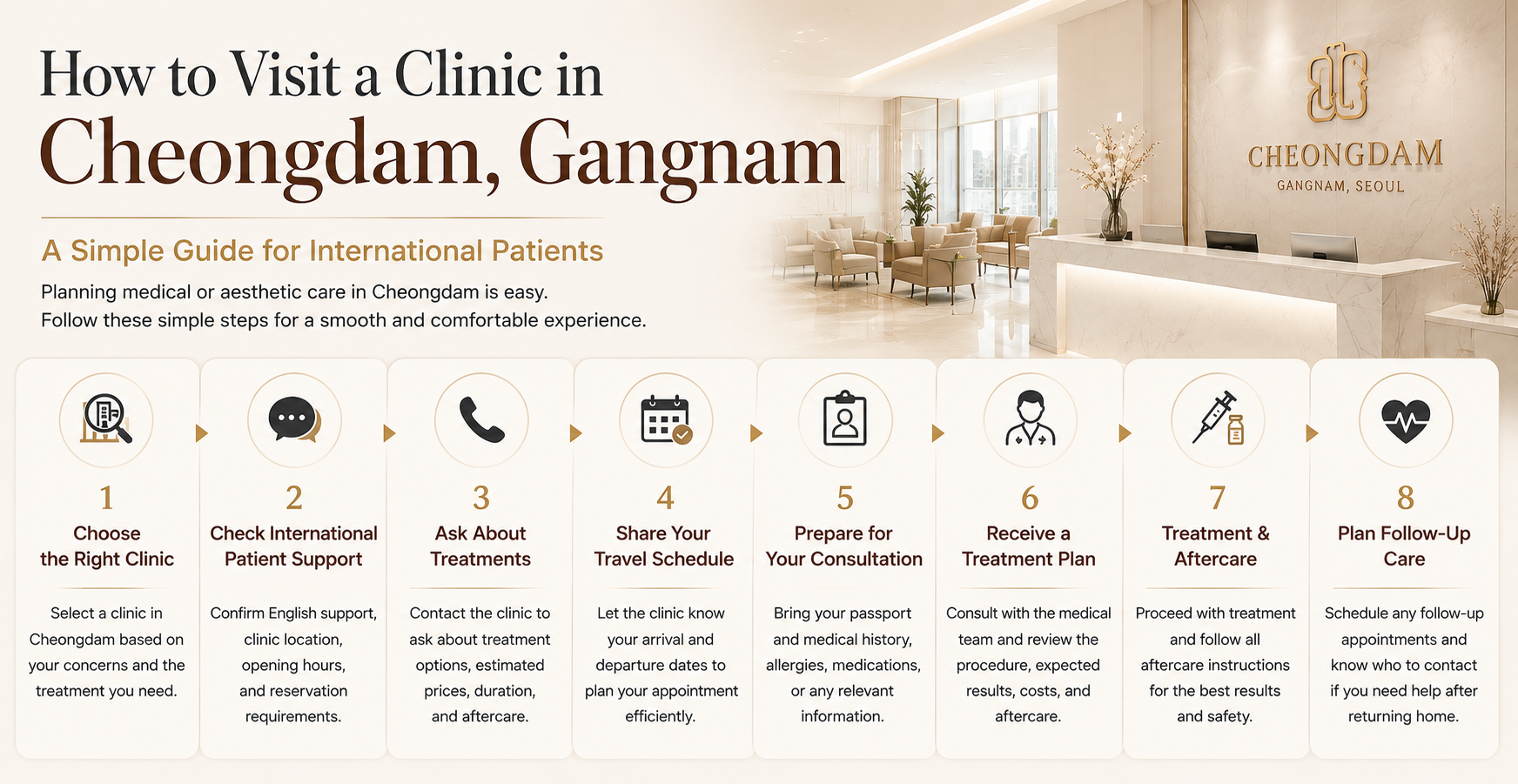
International patients considering facial fat grafting in Cheongdam should plan for the entire treatment process rather than only the procedure itself.
Before traveling, prepare information about previous surgeries, medications, allergies, and relevant medical history.
During consultation, ask about:
- English-language or interpretation support
- The surgeon performing the procedure
- The proposed donor area
- Facial areas to be treated
- Fat-processing technique
- Injection technique
- Anesthesia or sedation
- Expected swelling and bruising
- Follow-up schedule
- Emergency contact arrangements
- Recommended length of stay in Seoul
It is also important to understand what happens if the result requires additional treatment or if a complication develops after returning home.
A short medical-tourism itinerary should not be assumed to be sufficient for every patient.
How Much Does Facial Fat Grafting in Cheongdam Cost?
There is no universal price for facial fat grafting in Cheongdam.
The total cost can vary according to:
- Number of facial areas treated
- Amount of fat required
- Donor area
- Liposuction technique
- Fat-processing method
- Surgical technique
- Anesthesia or sedation
- Facility fees
- Postoperative care
- Additional procedures
- Possible repeat grafting
International patients should also consider accommodation, transportation, flights, medications, interpretation, and possible additional nights in Seoul.
When comparing quotations, ask for a detailed breakdown rather than focusing only on an advertised starting price. Confirm whether harvesting, anesthesia, facility charges, medication, follow-up visits, and postoperative care are included.
Questions to Ask Before Facial Fat Grafting
Before choosing a facial fat grafting provider in Cheongdam, consider asking:
- Which areas of my face would benefit from fat grafting?
- Where will the donor fat be harvested?
- How much fat do you expect to transfer?
- How will the fat be processed?
- What injection technique will be used?
- How much volume may realistically remain?
- Could I need another session?
- What are the risks for the areas being treated?
- Who will perform the procedure?
- What type of anesthesia or sedation is planned?
- How long should I stay in Seoul?
- When can I safely fly home?
- What follow-up appointments are required?
- What happens if the result is uneven?
- What is included in the total cost?
A thorough consultation should explain both the potential benefits and the uncertainty surrounding long-term fat retention.
Conclusion
Facial fat grafting in Cheongdam can be an option for patients seeking restoration of facial volume using their own fat. It may be considered for areas such as the cheeks, temples, forehead, under-eye region, and selected facial contours, depending on individual anatomy.
The procedure has an important advantage in using autologous tissue, but the amount of fat that ultimately survives cannot be predicted precisely. Research has demonstrated substantial variation in fat-retention rates between patients and techniques.
Safety should also remain a central consideration. Although serious complications are uncommon, vascular complications after facial fat injection can be severe, making qualified medical care and careful attention to facial anatomy essential.
For international patients, the best decision involves evaluating the surgeon, technique, treatment plan, recovery requirements, communication, follow-up arrangements, and total costs together. Cheongdam can be a convenient Seoul location for researching cosmetic surgery, but the individual medical team and treatment plan should remain the priority.
FAQs About Facial Fat Grafting in Cheongdam
What is facial fat grafting?
Facial fat grafting transfers fat from one area of the patient's body to selected areas of the face to restore or add soft-tissue volume.
Is facial fat grafting permanent?
Some transferred fat can survive long term, but not all grafted fat is retained. The final amount varies between individuals and techniques, so permanent volume cannot be guaranteed.
Which facial areas can be treated with fat grafting?
Depending on the patient's anatomy and goals, fat may be transferred to the cheeks, temples, forehead, under-eye region, nasolabial area, chin, or other selected facial areas.
Is facial fat grafting better than fillers?
Not necessarily. Fat grafting and dermal fillers have different benefits, limitations, risks, and recovery requirements. The appropriate choice depends on the individual patient.
Can facial fat grafting be combined with a facelift?
In selected patients, fat grafting can be combined with facelift surgery when both volume loss and tissue laxity are present. The combination should be determined during an individualized consultation.
What are the risks of facial fat grafting?
Possible complications include swelling, bruising, asymmetry, contour irregularities, fat necrosis, oil cysts, infection, and over- or undercorrection. Rare vascular complications can cause serious visual or neurological problems.
How long does recovery take?
Early swelling and bruising generally improve progressively, but the final appearance can take several months to stabilize as swelling resolves and retained fat becomes established.
Can foreigners get facial fat grafting in Cheongdam?
International patients can seek cosmetic surgery in Seoul, including facial fat grafting. Before booking, confirm language support, postoperative follow-up, emergency arrangements, and the recommended length of stay.
Could I need a second fat-grafting procedure?
Yes. Because fat retention varies, some patients may consider additional grafting if the desired volume is not achieved or changes over time. A surgeon should discuss this possibility before the initial procedure.