Forehead Fat Grafting Cheongdam Seoul Clinic
Forehead Fat Grafting and Facial Volume Restoration in Korea
Forehead Fat Grafting in Cheongdam, Seoul provides personalized surgical care for international patients seeking natural-looking forehead volume and smoother facial contours in Korea. Treatment may use the patient’s own fat to improve forehead fullness and balance based on individual facial structure and aesthetic goals. International patients can access patient-focused forehead fat grafting care in Cheongdam, Gangnam, with support designed to make treatment in Seoul easier and more comfortable.
What Is Forehead Fat Grafting?
Forehead fat grafting is a cosmetic procedure that uses the patient’s own fat to add volume to a flat, hollow, or uneven forehead. Fat is collected from another area of the body, processed, and carefully injected into selected areas of the forehead to create a smoother and more balanced contour.
The procedure can be used to improve forehead shape and facial proportions while using the patient’s own tissue. Because forehead anatomy and facial proportions vary between individuals, the amount and placement of fat should be carefully planned.
Forehead Fat Grafting in Cheongdam, Seoul
Forehead fat grafting in Cheongdam may be considered by patients who want a fuller, smoother forehead contour without using permanent implants. The treatment can address localized volume deficiency while taking the overall relationship between the forehead, eyebrows, nose, and midface into account.
A personalized consultation is important because adding too much volume can make the forehead appear overly prominent, while insufficient correction may not create the desired contour.
What Does Forehead Fat Grafting Address?
Forehead fat grafting may help improve several types of contour concerns, including:
- A flat or narrow-looking forehead
- Hollow areas of the forehead
- Irregular forehead contours
- Age-related forehead volume loss
- Certain soft-tissue asymmetries
- A lack of smooth transition between the forehead and upper face
- Facial proportions that appear unbalanced due to insufficient forehead volume
The goal is generally to create a natural-looking transition rather than simply making the forehead larger.
Forehead Fat Grafting Techniques in Cheongdam
Fat Harvesting
Fat is collected from a suitable donor area, often through a small liposuction procedure. The selected area depends on the patient’s body composition and the amount of fat required.
Fat Processing
The harvested fat is processed to prepare suitable tissue for transfer. Careful preparation allows the surgeon to use the fat for controlled placement in the forehead.
Layered Fat Injection
Fat may be injected in small amounts into carefully selected layers of the forehead. The surgeon considers the forehead’s shape, skin thickness, symmetry, and desired contour when determining the placement.
Forehead Fat Grafting and Facial Proportions
The forehead is closely connected to the appearance of the eyebrows, nose, temples, and midface. For this reason, forehead fat grafting is usually planned as part of the overall facial balance rather than as an isolated volume procedure.
In some patients, additional treatment of the temples or other areas may be considered if volume deficiency extends beyond the forehead.
Forehead Fat Grafting and Temple Volume
Forehead and temple hollowing can sometimes occur together, particularly with age-related facial volume loss or naturally lean facial features. When appropriate, fat grafting may be used to address both areas during the same treatment.
However, the required volume and injection technique can differ between the forehead and temples, so each area should be evaluated separately.
Forehead Fat Grafting and Other Facial Procedures
Forehead fat grafting may sometimes be combined with other facial procedures when multiple concerns are present. Depending on the individual case, patients may discuss options such as eyelid surgery, rhinoplasty, facelift, or other facial contouring procedures.
The combination should be based on facial anatomy, surgical safety, and the patient’s specific goals rather than simply combining multiple treatments.
Repeat Forehead Fat Grafting
A portion of transferred fat may naturally be absorbed during the healing process. As a result, the initial postoperative volume may decrease as the forehead gradually settles.
If additional correction is needed after the result has stabilized, some patients may consider repeat fat grafting. Whether this is appropriate depends on the amount of retained fat and the desired final contour.
What Are the Possible Risks of Forehead Fat Grafting?
Forehead fat grafting has potential risks and side effects, as with other surgical procedures. These may include:
- Swelling and bruising
- Temporary discomfort or numbness
- Infection
- Asymmetry
- Irregular contours
- Fat absorption
- Overcorrection or undercorrection
- Visible or palpable irregularities
- Changes in forehead proportions
- Rare but serious vascular complications
Because the forehead contains important blood vessels, careful technique and appropriate patient evaluation are particularly important.
Who Should Consider Forehead Fat Grafting?
Forehead fat grafting may be suitable for adults who have insufficient forehead volume and want to improve their facial contour using their own fat.
It may be considered for patients with a naturally flat forehead, localized hollowing, or volume loss associated with aging. Patients should have sufficient donor fat and realistic expectations regarding fat retention and the final result.
Forehead Fat Grafting for Foreigners in Seoul, Korea
International patients considering forehead fat grafting in Seoul should discuss the desired forehead shape and overall facial proportions during consultation. The surgeon can evaluate the forehead, temples, eyebrows, and surrounding facial structures before developing an individualized treatment plan.
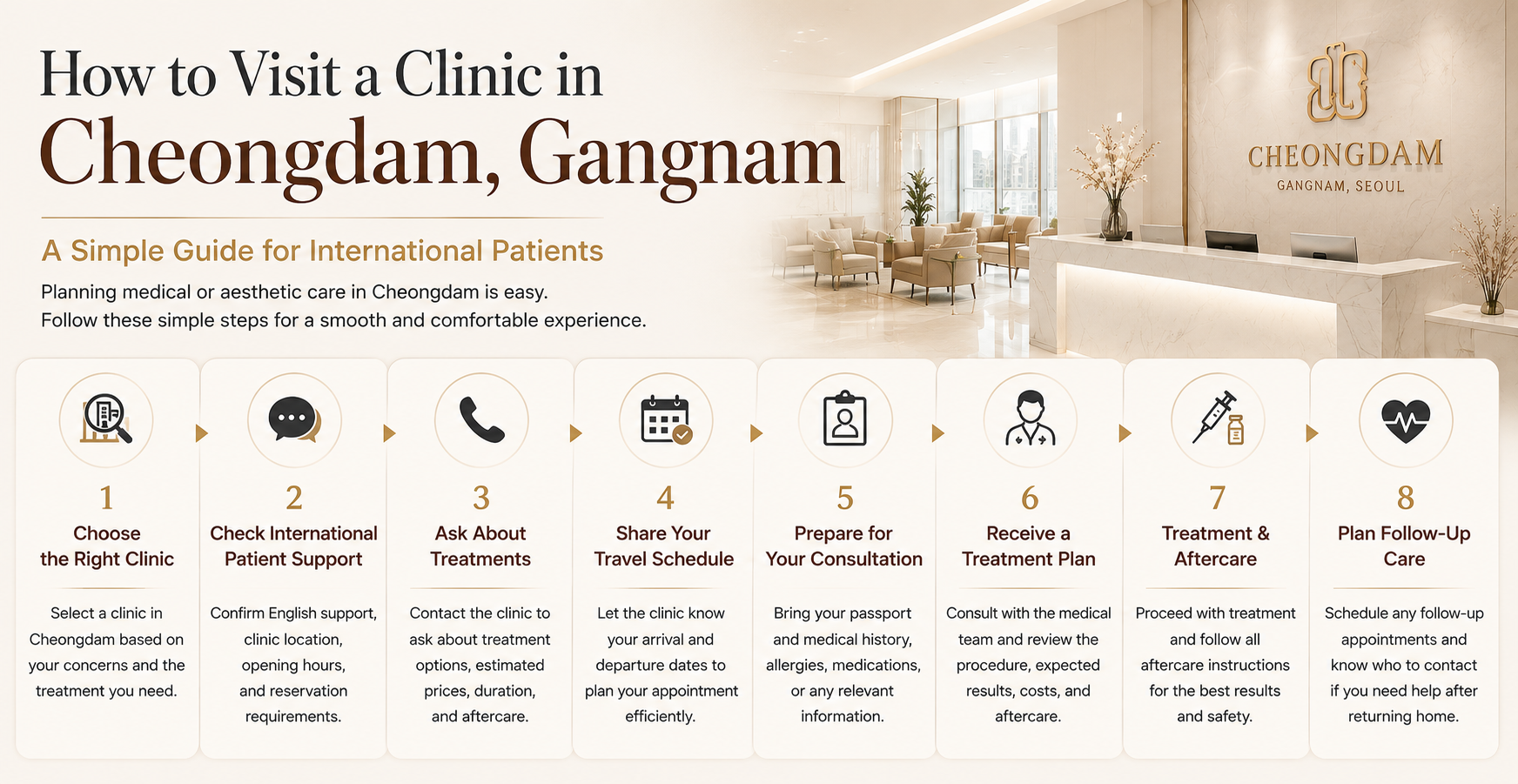
Foreign patients should also confirm consultation language, surgery and recovery timelines, follow-up arrangements, and aftercare instructions before scheduling treatment.
Forehead Fat Grafting Consultation and Surgery Process in Seoul
The treatment process commonly includes:
- Initial consultation – The forehead shape, facial proportions, medical history, and aesthetic goals are evaluated.
- Treatment planning – The required volume, donor area, and injection sites are determined.
- Fat harvesting – Fat is collected from an appropriate donor area.
- Fat preparation – The harvested tissue is processed for transfer.
- Fat injection – Small amounts of prepared fat are placed into the planned forehead areas.
- Recovery and follow-up – Swelling and contour changes are monitored as the grafted fat settles.
Forehead Fat Grafting vs. Forehead Implants
Forehead fat grafting and forehead implants can both increase forehead projection, but they use different approaches. Fat grafting uses the patient’s own tissue and can provide a softer, more adjustable contour, while an implant provides a predefined structural shape.
The appropriate option depends on the desired degree of augmentation, facial anatomy, and the patient’s preference regarding the type of procedure.
Forehead Fat Grafting vs. Dermal Fillers
Dermal fillers can add forehead volume without fat harvesting, while fat grafting involves collecting and transferring the patient’s own fat.
Fillers may be considered when a patient wants a less invasive or temporary approach. Forehead fat grafting may be considered when broader volume restoration or the use of autologous tissue is preferred.
Forehead Fat Grafting for Women and Men in Cheongdam
Forehead fat grafting can be performed for both women and men. However, ideal forehead contours can differ according to facial structure, bone anatomy, and aesthetic preferences.
The amount and placement of fat should therefore be individualized rather than based solely on gender.
Forehead Fat Grafting Care in Cheongdam, Seoul
Swelling and bruising are common during the early recovery period. Patients may be advised to avoid unnecessary pressure or manipulation of the forehead and to follow their surgeon’s specific instructions regarding activity and skincare.
The forehead may look fuller immediately after treatment because of postoperative swelling. The contour gradually changes as swelling decreases and the transferred fat stabilizes.
Frequently Asked Questions
Is forehead fat grafting permanent?
Some transferred fat can survive long term, but a portion is typically absorbed by the body. Long-term volume retention varies from person to person.
Where is fat taken from for forehead fat grafting?
Fat may be harvested from areas such as the abdomen or thighs, depending on the patient’s available donor tissue and the amount required.
Can forehead fat grafting make the forehead look too large?
Overcorrection is a potential concern. Careful assessment and controlled fat placement are important for maintaining balanced facial proportions.
How long does swelling last after forehead fat grafting?
Swelling varies depending on the individual and the amount of fat transferred. It generally decreases gradually during recovery, while the final contour takes longer to stabilize.
Can forehead fat grafting be combined with temple fat grafting?
Yes, forehead and temple volume deficiency may sometimes be addressed during the same procedure when clinically appropriate.
Is forehead fat grafting better than fillers?
Neither treatment is universally better. The appropriate choice depends on the desired volume, treatment area, longevity preferences, and whether the patient wants to undergo fat harvesting.
Can forehead fat grafting be repeated?
Additional grafting may be considered after the initial result has stabilized if further volume correction is appropriate.
Forehead Fat Grafting Consultation in Cheongdam, Seoul
A personalized consultation is an important step when considering forehead fat grafting in Cheongdam. The surgeon can evaluate forehead shape, facial proportions, donor fat availability, and the amount of augmentation that may be appropriate.
For international patients seeking
forehead fat grafting in Seoul, Korea, discussing the surgical technique, expected recovery, possible risks, and follow-up plan in advance can help create a clearer treatment experience.