Microneedling Cheongdam Seoul Clinic
Collagen Induction Therapy and Skin Rejuvenation in Korea
Microneedling in Cheongdam, Seoul is a minimally invasive skin treatment that uses fine needles to create controlled microchannels in the skin and may be considered for selected concerns such as acne scars, uneven texture, fine lines, and enlarged-looking pores. Patients considering collagen induction therapy in Korea should receive an individualized skin assessment to determine appropriate needle depth, treatment area, number of sessions, expected downtime, pigmentation risk, and whether conventional microneedling or another resurfacing treatment is more suitable.
Microneedling Treatment in Cheongdam, Seoul
Microneedling is a minimally invasive skin-remodeling treatment performed using a device containing multiple fine needles.
The needles repeatedly enter and leave the skin at controlled depths, creating microscopic treatment channels.
This controlled injury initiates a natural wound-healing response and can contribute to remodeling of collagen-containing tissue over time.
Microneedling is commonly considered for concerns involving acne scars, uneven skin texture, fine lines, and enlarged-looking pores.
What Is Microneedling?
Microneedling is a procedure in which very small needles create multiple controlled punctures in the skin.
Devices may include motorized pen-style systems, stamping devices, or other medical microneedling platforms.
Professional medical devices can allow the practitioner to adjust treatment depth according to the anatomical area and skin concern.
Microneedling is sometimes called collagen induction therapy because the controlled injury is intended to stimulate tissue-remodeling processes involving collagen.
How Does Microneedling Work?
Microneedles penetrate the skin and create microscopic channels.
This controlled injury activates the body's wound-healing response.
During healing, cellular signaling and tissue remodeling can influence collagen and other components of the extracellular matrix.
Visible improvement therefore develops gradually rather than immediately.
The degree of remodeling depends on needle depth, number of passes, treatment area, baseline skin condition, healing response, and treatment schedule.
What Is Collagen Induction Therapy?
Collagen induction therapy is another term commonly used for medical microneedling.
The name reflects the goal of encouraging skin remodeling through controlled needle injury.
Microneedling does not inject collagen directly into the skin.
Instead, it relies on the patient's biological healing response.
The treatment should therefore not be interpreted as producing unlimited or permanent collagen regeneration.
What Can Microneedling Treat?
Depending on the medical device, needle depth, skin condition, and treatment plan, microneedling may be considered for:
- Atrophic acne scars
- Uneven skin texture
- Fine lines and wrinkles
- Enlarged-looking pores
- Selected surgical or traumatic scars
- Mild skin-quality concerns
- Overall skin rejuvenation
Not every condition responds equally well.
Pigmentation, vascular redness, deep scars, active acne, and significant skin laxity may require different treatments.
Microneedling for Acne Scars
Acne scars are one of the most common reasons patients consider microneedling.
The treatment may improve selected atrophic acne scars by creating controlled injury and stimulating dermal remodeling.
However, acne scars vary in structure.
Rolling scars, boxcar scars, and ice-pick scars do not necessarily respond the same way.
Deep tethered rolling scars may require subcision, while narrow ice-pick scars may require another targeted procedure.
Microneedling can therefore be one part of a broader scar-treatment strategy.
Can Microneedling Remove Acne Scars Completely?
Complete removal of acne scars should not be guaranteed.
The goal is generally to reduce scar visibility and improve overall skin texture.
Results depend on scar type, scar depth, age of the scar, skin characteristics, treatment intensity, and individual healing response.
Patients with mixed scar patterns may require combination treatment.
Microneedling for Enlarged Pores
Pore visibility can be influenced by genetics, sebum production, acne, aging, and changes in skin elasticity.
Microneedling may improve overall texture and make enlarged-looking pores appear less noticeable in selected patients.
However, pores are normal anatomical structures.
Treatment cannot permanently erase them from the skin, much as certain advertisements seem personally offended by their existence.
Microneedling for Fine Lines
Fine lines can develop because of age-related collagen changes, sun exposure, dryness, and repeated facial movement.
Microneedling may improve selected fine lines by encouraging tissue remodeling.
Dynamic wrinkles caused primarily by facial muscle movement may respond more directly to botulinum toxin.
Deeper wrinkles associated with volume loss or pronounced laxity may require other approaches.
Microneedling for Skin Texture
Uneven skin texture may result from acne scars, enlarged-looking pores, aging, or previous skin inflammation.
Microneedling can create a controlled remodeling response that gradually improves selected texture concerns.
Multiple sessions may be required.
The intensity and depth should be adjusted according to the condition being treated rather than applying one setting to the entire face.
Microneedling for Skin Rejuvenation
Microneedling is commonly included within the broad category of skin-rejuvenation treatments.
Patients may consider it for texture, fine lines, early signs of aging, or overall skin quality.
However, “rejuvenation” is a broad aesthetic goal rather than one measurable medical diagnosis.
A consultation should identify the actual skin concern before determining whether microneedling is appropriate.
Does Microneedling Tighten Skin?
Collagen remodeling may contribute to modest changes in skin firmness.
However, conventional microneedling is not primarily a deep-tissue lifting treatment.
It cannot remove substantial excess skin or reproduce the effects of surgical lifting, HIFU, or certain RF tightening procedures.
Patients with significant laxity may require another treatment strategy.
Does Microneedling Stimulate Collagen?
Microneedling creates controlled mechanical injury that triggers normal wound-healing and remodeling processes.
These processes involve fibroblast activity and collagen deposition.
This is the biological basis for the term collagen induction therapy.
However, visible results vary and should not be described as guaranteed collagen regeneration.
Microneedling vs. RF Microneedling
Conventional microneedling and RF microneedling are different procedures.
Conventional microneedling creates mechanical micro-injury using needles.
RF microneedling additionally delivers radiofrequency energy through or between needle electrodes, generating controlled thermal effects below the skin.
RF microneedling platforms include systems such as Potenza, Sylfirm X, and Morpheus8.
The addition of RF changes the mechanism, treatment intensity, risk profile, and potential tissue effects.
Microneedling vs. Potenza
Potenza is an RF microneedling platform.
Conventional microneedling uses needles without delivering RF heat into the tissue.
Potenza may be selected when both mechanical and thermal remodeling are desired, while conventional microneedling may be appropriate when a simpler mechanical collagen-induction approach is preferred.
Neither is automatically better for every patient.
Microneedling vs. Sylfirm X
Sylfirm X combines microneedles with bipolar RF energy and offers multiple RF modes.
Conventional microneedling does not deliver RF energy.
Both can be used in broader skin-remodeling strategies, but treatment intensity, indications, downtime, and risk differ.
Microneedling vs. Fraxel
Fraxel uses fractional laser energy.
Microneedling uses fine needles to create mechanical microchannels.
Both may be considered for acne scars, texture, and selected fine lines, but they create controlled injury through different mechanisms.
Laser treatment may involve greater pigment interaction, while microneedling is not dependent on a light wavelength.
Microneedling vs. CO2 Laser
Fractional CO2 laser is an ablative resurfacing treatment.
It creates microscopic columns of thermal injury and tissue ablation.
Microneedling produces mechanical channels without ablative laser energy.
CO2 laser may offer more aggressive resurfacing in selected patients but generally involves greater downtime and pigmentation risk.
Microneedling vs. Pico Laser
Pico lasers deliver very short laser pulses and are commonly used for selected pigmentation, tattoo, and rejuvenation treatments.
Microneedling uses mechanical needle injury.
If pigmentation is the primary concern, a pigment-focused treatment may be more appropriate.
If texture or atrophic scarring is the main issue, microneedling may be considered depending on the scar pattern.
Microneedling vs. Chemical Peel
Chemical peels create controlled skin injury using chemical agents.
Microneedling uses physical needles.
Both can improve selected texture or surface concerns, but their mechanisms and ideal indications differ.
Treatment selection should consider skin type, pigmentation history, scar characteristics, and desired downtime.
Microneedling vs. Dermaroller
A dermaroller is one type of microneedling device that uses needles attached to a rotating cylinder.
Professional motorized microneedling pens instead move needles vertically into and out of the skin.
The depth, consistency, sterility, and treatment control may differ substantially between devices.
Patients should ask what system is being used during professional treatment.
Professional Microneedling vs. Home Dermarolling
Professional microneedling devices can penetrate deeper skin layers and may be used as medical devices.
Home rollers generally use shorter needles intended primarily for superficial cosmetic effects.
Deeper microneedling carries greater risks involving bleeding, infection, pigmentation changes, and skin injury.
Medical microneedling should therefore not be treated as the same procedure as casually rolling a device across the bathroom mirror at midnight because social media seemed persuasive.
What Needle Depth Is Used for Microneedling?
Needle depth depends on:
- Treatment area
- Skin thickness
- Scar depth
- Treatment goal
- Device specifications
- Patient tolerance
- Practitioner assessment
Superficial areas may require shorter depths, while scar treatment may involve deeper penetration.
There is no universal ideal depth for the entire face.
Deeper treatment is not automatically more effective.
Is Microneedling Painful?
Treatment sensation depends on needle depth, device speed, treatment area, and individual sensitivity.
Patients may experience prickling, pressure, stinging, or discomfort.
Topical anesthetic is commonly used before deeper professional microneedling to improve comfort.
What Happens During Microneedling?
Before treatment, the skin is assessed and cleansed.
Topical anesthetic may be applied when appropriate.
A sterile microneedling cartridge is then moved across selected treatment areas using controlled needle depth and technique.
Temporary pinpoint bleeding may occur with deeper medical microneedling.
The treatment plan should be adjusted according to different facial zones rather than using identical settings everywhere.
What Happens After Microneedling?
Following treatment, patients may experience:
- Redness
- Warmth
- Mild swelling
- Tightness
- Tenderness
- Dryness
- Mild peeling
- Minor crusting
- Temporary sensitivity
These effects usually improve during the recovery period.
Patients should avoid picking or aggressively exfoliating treated skin.
How Much Downtime Does Microneedling Have?
Downtime depends on treatment depth and intensity.
A superficial session may cause mild redness for a relatively short period.
Deeper treatment for scars can produce more noticeable redness, swelling, dryness, or crusting.
Patients should ask about expected social downtime before treatment.
When Will I See Microneedling Results?
Initial changes in skin appearance may become noticeable after the healing period.
Collagen remodeling develops more gradually over subsequent weeks and months.
Patients undergoing treatment for acne scars generally require time and often multiple sessions before substantial improvement can be evaluated.
How Many Microneedling Sessions Do I Need?
There is no universal number.
Treatment frequency depends on:
- Skin concern
- Scar type
- Scar severity
- Needle depth
- Skin recovery
- Previous treatments
- Individual response
Multiple procedures may be necessary to achieve the desired improvement.
The skin should be allowed adequate recovery between sessions.
How Long Do Microneedling Results Last?
Remodeling-related improvement may persist for some time, particularly in scars and texture.
However, skin continues to age.
New acne can also create new scars.
Maintenance treatment may be considered depending on the concern and individual goals.
Permanent rejuvenation should not be guaranteed.
Is Microneedling Safe for Asian Skin?
Microneedling can be considered across a range of skin tones because it does not rely on pigment-selective laser absorption.
However, inflammation from treatment can still trigger post-inflammatory hyperpigmentation (PIH).
Patients with a history of PIH, melasma, or other pigmentary problems should tell their healthcare provider before treatment.
Conservative technique and appropriate aftercare remain important.
Can Microneedling Cause Hyperpigmentation?
Yes.
Any procedure that creates inflammation can potentially trigger post-inflammatory hyperpigmentation.
Risk varies according to skin type, treatment depth, sun exposure, inflammation, previous pigmentation history, and aftercare.
Patients should use appropriate sun protection during recovery.
Can Microneedling Cause Scarring?
Scarring is uncommon with appropriately performed treatment but is a possible complication.
Risk may increase with excessive needle depth, aggressive repeated passes, infection, poor wound healing, or inappropriate treatment of patients prone to abnormal scarring.
Patients with a history of keloids or hypertrophic scars should discuss this before treatment.
Can Microneedling Cause Infection?
Yes.
Microneedling temporarily disrupts the protective barrier of the skin.
Improperly cleaned devices or reused needle cartridges can spread infection.
Professional clinics should use appropriate infection-control procedures and a new sterile needle cartridge for each treatment session.
Can Microneedling Trigger Cold Sores?
Microneedling may reactivate herpes simplex in patients with a history of cold sores.
Patients should tell their healthcare provider about previous herpes outbreaks.
Preventive antiviral medication may sometimes be considered according to individual risk.
What Are the Possible Side Effects of Microneedling?
Common temporary reactions may include:
- Redness
- Dryness
- Roughness
- Tightness
- Itching
- Peeling
- Burning
- Bruising
- Bleeding
- Crusting
Less common complications can include:
- Hyperpigmentation
- Hypopigmentation
- Infection
- Herpes reactivation
- Persistent irritation
- Scarring
- Unwanted textural changes
Risks depend on needle depth, device, technique, skin condition, and individual healing response.
Who May Not Be Suitable for Microneedling?
Microneedling may need to be avoided or postponed in some patients.
Relevant factors can include:
- Active bacterial, viral, or fungal skin infection
- Active herpes outbreak
- Active rash or significant dermatitis
- Certain bleeding or clotting disorders
- Anticoagulant therapy
- Impaired immune function
- Poorly controlled diabetes
- Certain autoimmune or skin conditions
- Keloid tendency
- Pregnancy or breastfeeding
- Certain medications
- Recent isotretinoin use depending on device guidance and clinical circumstances
Suitability should be assessed individually.
Microneedling With PRP
Microneedling is sometimes combined with platelet-rich plasma, or PRP.
PRP is prepared from the patient's blood and contains concentrated platelets.
The combination should not automatically be considered part of standard microneedling.
Patients should understand that the microneedling device and the biological product are separate components of treatment, each with its own evidence and considerations.
Microneedling With Exosomes
Some aesthetic clinics combine microneedling with products marketed as exosomes or cell-derived regenerative products.
These products should be assessed separately from the microneedling procedure itself.
Patients should ask exactly what product is being applied, whether it is intended for use on disrupted skin, and what regulatory and clinical evidence supports that use.
Microscopic holes are not regulatory portals through which every serum acquires a medical indication.
Microneedling With Skin Boosters
Skin boosters and microneedling are also separate treatments.
Some clinics may apply products after creating microchannels or offer injectable skin boosters in the same treatment plan.
Patients should clarify whether a product is being:
- Applied topically
- Delivered through treatment-created channels
- Injected separately
- Used under another approved protocol
These routes are not equivalent.
Is Microneedling Approved for Delivering Serums Into the Skin?
Patients should be cautious with this claim.
The U.S. FDA states that authorized microneedling devices have not been cleared for delivery of cosmetics, topical medications, vitamins, drugs, or blood products such as PRP into the skin.
The safety and evidence of any combination should therefore be evaluated according to the exact device, product, and regulatory framework applicable in Korea.
Microneedling Aftercare
Patients should follow clinic-specific instructions.
General aftercare may include:
- Gentle cleansing
- Appropriate moisturizer
- Careful sun protection
- Avoiding unnecessary heat and irritation
- Avoiding picking or scrubbing
- Temporarily avoiding strong exfoliating acids or retinoids
- Delaying irritating cosmetic products until the skin has recovered
Skin may temporarily become more sensitive to skincare products following treatment.
When Can I Wear Makeup After Microneedling?
The appropriate timing depends on treatment depth and skin recovery.
Patients should follow the healthcare provider's instructions before applying makeup to recently treated skin.
Using makeup too soon may increase irritation or contamination risk when the skin barrier is still disrupted.
When Can I Exercise After Microneedling?
Strenuous exercise can increase heat and sweating, which may irritate recently treated skin.
The appropriate interval depends on treatment intensity and individual recovery.
Patients should follow the clinic's specific aftercare recommendations.
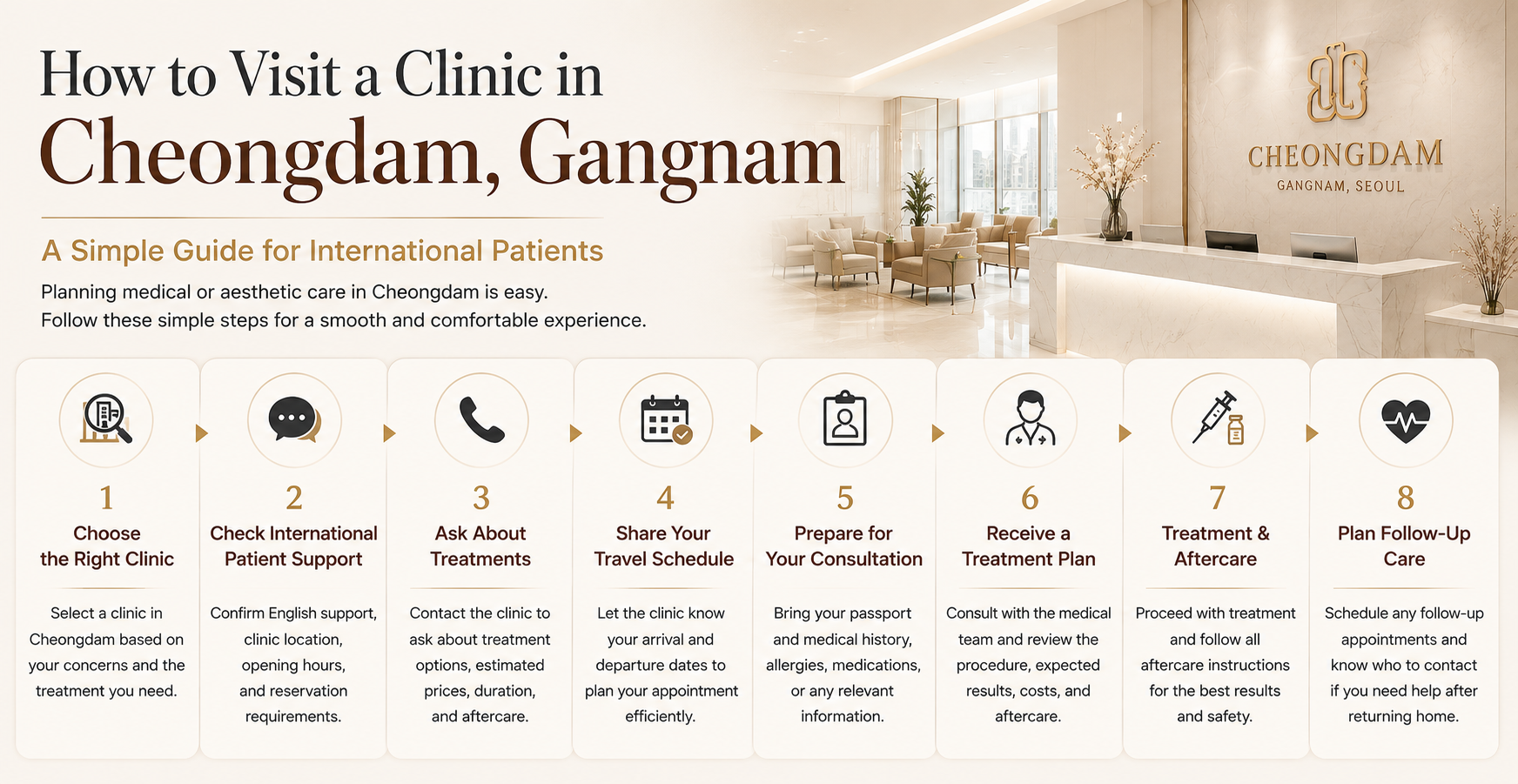
Microneedling for Foreigners in Seoul, Korea
International residents, expatriates, students, business travelers, and visitors may seek microneedling while living in or traveling to Seoul.
Foreign patients considering microneedling in Cheongdam or Gangnam may wish to ask about:
- The exact microneedling device
- Needle depth
- Treatment areas
- Sterile single-use needle cartridges
- Whether conventional or RF microneedling is being offered
- Number of sessions
- Expected downtime
- PIH risk
- Combination products
- English-language consultation
- Pricing and follow-up care
Patients should disclose previous acne-scar treatment, laser procedures, RF microneedling, medications, isotretinoin history, keloids, cold sores, and pigmentation problems.
Choosing a Microneedling Clinic in Cheongdam
Patients should look beyond inexpensive package pricing.
Important considerations include:
- Appropriate medical assessment
- Authentic professional equipment
- Sterile single-use cartridges
- Healthcare professional training
- Individualized needle depth
- Accurate acne-scar diagnosis
- Pigmentation-risk assessment
- Infection-control procedures
- Realistic expectations
- Clear aftercare
For scar treatment, simply asking how deep the needles go is not enough.
The useful question is why that depth is appropriate for that particular scar and that particular area of skin.
Frequently Asked Questions
What is microneedling?
Microneedling is a minimally invasive treatment that uses fine needles to create controlled microchannels in the skin and stimulate a wound-healing and tissue-remodeling response.
Is microneedling the same as collagen induction therapy?
Yes. Collagen induction therapy is a commonly used term for professional microneedling.
Does microneedling stimulate collagen?
Microneedling creates controlled tissue injury that initiates wound-healing processes involving collagen remodeling.
Is microneedling good for acne scars?
Microneedling may improve selected atrophic facial acne scars. Scar type and severity should be evaluated before treatment.
Can microneedling completely remove acne scars?
No treatment should guarantee complete scar removal. The goal is generally improvement in scar visibility and skin texture.
Does microneedling help enlarged pores?
It may improve overall texture and make enlarged-looking pores less noticeable, but pores cannot be permanently removed.
Can microneedling improve wrinkles?
Medical microneedling devices are used for selected facial wrinkle concerns, although the appropriate treatment depends on the type and depth of the wrinkle.
Is microneedling the same as RF microneedling?
No. RF microneedling adds radiofrequency heating through needle electrodes, while conventional microneedling relies primarily on mechanical micro-injury.
Is microneedling the same as Potenza?
No. Potenza is an RF microneedling platform.
Is microneedling the same as Fraxel?
No. Fraxel uses fractional laser energy, while microneedling uses mechanical needle penetration.
Is microneedling painful?
Patients may experience prickling, stinging, or pressure. Topical anesthetic is commonly used for deeper professional treatments.
How long is microneedling downtime?
Downtime varies according to depth and intensity. Redness, swelling, dryness, tightness, tenderness, or minor crusting may occur.
How many microneedling treatments are needed?
Multiple sessions may be recommended depending on scar severity, skin condition, treatment depth, and individual response.
Can microneedling cause pigmentation?
Yes. Post-inflammatory hyperpigmentation or, less commonly, hypopigmentation can occur.
Can microneedling cause infection?
Yes. Skin-barrier disruption and contaminated or reused cartridges can cause infection.
Can microneedling be combined with PRP or exosomes?
Combination treatments are offered in some clinics, but the microneedling procedure and added product should be evaluated separately for safety, evidence, and regulatory status.
Can foreigners get microneedling in Korea?
Yes. International residents and visitors can seek professional microneedling at Korean medical institutions. Devices, protocols, pricing, English-language assistance, and follow-up care vary by clinic.
Where can I get microneedling in Cheongdam, Seoul?
Patients considering microneedling can consult qualified medical professionals in Cheongdam and the surrounding Gangnam area. A skin assessment can determine whether conventional microneedling is suitable, which areas should be treated, and what needle depth and treatment schedule are appropriate.
Microneedling Consultation in Cheongdam, Seoul
Microneedling may be considered by patients seeking collagen induction therapy for selected acne scars, uneven texture, enlarged-looking pores, fine lines, and overall skin rejuvenation.
Patients searching for
Microneedling Cheongdam,
Microneedling Seoul,
Collagen Induction Therapy Korea,
Acne Scar Microneedling Gangnam,
Skin Rejuvenation Seoul, or
Microneedling for Foreigners in Korea can consult a qualified healthcare professional to discuss appropriate treatment depth, expected results, downtime, pigmentation risk, potential side effects, and individualized treatment planning.