Glass Skin Facial Cheongdam Seoul Clinic
Korean Skin Glow and Hydration Treatment in Korea
Glass Skin Facial in Cheongdam, Seoul is a personalized Korean skin-rejuvenation concept focused on creating a smoother, more hydrated, luminous, and even-looking complexion through treatments selected according to the patient’s skin condition. Because “glass skin” is not one standardized medical procedure, patients should confirm which treatments and products are included and receive an individualized assessment for concerns such as dehydration, dullness, uneven texture, pores, pigmentation, or sensitivity.
Glass Skin Facial in Cheongdam, Seoul
“Glass skin” is a popular Korean beauty term used to describe skin that appears smooth, hydrated, luminous, and clear.
A Glass Skin Facial is therefore not one universal medical treatment.
Instead, clinics may use the term for personalized skin-care programs designed to improve hydration, texture, radiance, and overall skin appearance.
Depending on the patient and clinic, treatment may involve gentle cleansing, exfoliation, hydration-focused procedures, ultrasound treatment, lasers, skin boosters, or other aesthetic technologies.
The exact treatment plan matters considerably more than the name printed on the package.
What Is Glass Skin?
Glass skin generally refers to a complexion that appears:
- Hydrated
- Smooth
- Luminous
- Even in tone
- Refined in texture
- Healthy-looking
- Naturally reflective rather than oily
The term originated within Korean beauty culture and has become widely used internationally.
It does not represent a medical diagnosis or a specific level of skin health.
What Is a Glass Skin Facial?
A Glass Skin Facial is a broad cosmetic or medical-aesthetic treatment concept.
The treatment goal is usually to improve several visible aspects of skin quality at the same time rather than target one isolated problem.
Depending on the clinic, a Glass Skin Facial may include treatments intended for:
- Hydration
- Gentle exfoliation
- Skin texture
- Dullness
- Enlarged-looking pores
- Superficial pigmentation
- Skin barrier support
- Overall radiance
Patients should ask exactly which treatments are included because two clinics offering “Glass Skin Facial” may be providing completely different procedures.
How Does a Glass Skin Facial Work?
There is no single mechanism because Glass Skin Facial protocols vary.
A personalized treatment may combine several strategies.
Hydration-focused treatments may help improve water content and skin comfort.
Gentle exfoliation may remove superficial dead skin cells and create a smoother-looking surface.
Laser or light-based treatments may address selected pigmentation or redness.
Skin boosters may be considered for hydration or texture.
Ultrasound or other energy-based treatments may be used for selected skin-quality goals.
The appropriate combination depends on the patient's actual skin condition.
What Makes Skin Look “Glassy”?
A glass-like appearance generally depends on several factors working together.
Smooth surface texture reflects light more evenly.
Adequate hydration can make skin appear plumper and more luminous.
Reduced visible pigmentation or redness may create a more uniform appearance.
Healthy barrier function can help maintain moisture and reduce roughness.
No single treatment can guarantee all of these characteristics in every patient.
Glass Skin Facial for Hydration
Hydration is one of the central goals of many Glass Skin Facial programs.
Dehydrated skin can appear dull, rough, tight, or more visibly lined.
Depending on the patient's condition, hydration-focused treatment may include moisturization, barrier-supporting care, ultrasound-based procedures, or selected injectable treatments.
Persistent dryness may also be associated with dermatitis, medications, climate, excessive exfoliation, or inappropriate skincare.
Glass Skin Facial for Dull Skin
Dull-looking skin can result from dryness, surface buildup, uneven pigmentation, sun damage, poor sleep, irritation, or other factors.
A Glass Skin Facial may improve brightness by addressing one or more of these contributors.
The goal should be a healthier and more even-looking complexion rather than artificially changing the patient's natural skin color.
Glass Skin Facial for Skin Glow
“Glow” is an aesthetic description rather than a medical endpoint.
Skin may appear more radiant when hydration, texture, and tone improve.
Treatments focused on superficial exfoliation, hydration, pigment control, and barrier support may all contribute to this appearance.
Results vary and generally require appropriate home skincare to maintain.
Glass Skin Facial for Uneven Texture
Uneven skin texture can be caused by dryness, enlarged-looking pores, acne scars, keratin buildup, aging, or previous inflammation.
A mild Glass Skin Facial may improve superficial roughness.
Deeper acne scars or significant textural irregularity generally require more targeted treatments such as fractional laser, RF microneedling, subcision, or other procedures.
Glass Skin Facial for Enlarged Pores
Pore visibility can be influenced by genetics, sebum production, skin elasticity, acne history, and aging.
Some Glass Skin Facial protocols may improve overall texture and make pores appear less noticeable.
However, pores are normal anatomical structures.
They cannot literally be closed or permanently removed, despite the remarkably hostile relationship between beauty advertising and sebaceous anatomy.
Glass Skin Facial for Pigmentation
Uneven pigmentation can reduce the appearance of skin clarity.
Depending on the diagnosis, a Glass Skin treatment plan may incorporate pigment-focused laser, toning, topical care, or sun protection.
However, freckles, lentigines, melasma, and post-inflammatory pigmentation are different conditions.
A proper diagnosis is important before energy-based treatment.
Glass Skin Facial for Melasma
Melasma is a chronic and recurrent pigmentary condition.
It should not be treated simply as “dull skin.”
Patients with melasma may require medical skincare, sun protection, pigment-regulating treatments, and careful use of lasers or energy devices.
A Glass Skin Facial should not be marketed as a permanent cure for melasma.
Glass Skin Facial for Sensitive Skin
Sensitive skin can react with redness, burning, stinging, tightness, or irritation.
Patients with sensitive skin may benefit from a more conservative program emphasizing hydration and barrier support.
Aggressive exfoliation, strong acids, multiple energy treatments, or unnecessary active ingredients may worsen irritation.
A treatment described as gentle should still be selected according to the patient's actual skin condition.
Glass Skin Facial for Acne-Prone Skin
Acne-prone patients may seek glass-skin treatments because of uneven texture, oiliness, pigmentation, or dullness.
However, active acne is a medical condition and may require targeted treatment.
Aggressive exfoliation or comedogenic products can worsen acne in some patients.
A treatment plan should distinguish active acne from post-acne pigmentation and scarring.
Does Glass Skin Facial Treat Acne Scars?
A superficial facial generally cannot substantially correct deep acne scars.
Rolling, boxcar, and ice-pick scars involve structural changes within the skin.
These may require treatments such as:
- Subcision
- RF microneedling
- Fractional laser
- TCA CROSS
- Combination scar treatment
A Glass Skin Facial may improve the surrounding skin quality but should not be promised to erase structural scars.
Glass Skin Facial vs. Hydrafacial
Hydrafacial is a specific branded treatment system combining cleansing, exfoliation, extraction, and serum delivery.
Glass Skin Facial is a broader treatment concept.
A clinic may include Hydrafacial within a glass-skin program, but the two terms are not automatically interchangeable.
Patients should confirm the exact equipment and products being used.
Glass Skin Facial vs. Aqua Peel
Aqua peel is a commonly used Korean term for hydrodermabrasion-style cleansing and exfoliation treatments.
It may be included in some Glass Skin Facial programs.
However, Aqua Peel generally focuses more on cleansing, superficial exfoliation, and hydration.
Glass Skin Facial may involve a broader combination of treatments depending on the clinic.
Glass Skin Facial vs. LDM
LDM uses multi-frequency ultrasound technology.
It is commonly discussed for selected hydration, barrier, redness, and skin-quality concerns.
LDM may be incorporated into a Glass Skin Facial when hydration or sensitive skin is part of the treatment goal.
However, Glass Skin Facial is the overall aesthetic concept, while LDM is a specific device-based treatment.
Glass Skin Facial vs. Rejuran
Rejuran is a PN-based injectable treatment.
A Glass Skin Facial may be entirely non-injectable or may include selected injectable procedures depending on the clinic.
Rejuran is generally associated with skin-quality and fine-line concerns rather than being synonymous with glass-skin treatment.
Glass Skin Facial vs. Skin Booster
Skin boosters are injectable treatments that may contain hyaluronic acid, polynucleotides, PDLLA, or other materials.
Some clinics may include a skin booster within a premium Glass Skin program.
Patients should understand whether their facial involves only topical and device-based treatment or actual injections.
Those are not minor differences disguised by the shared presence of the word “glow.”
Glass Skin Facial vs. Laser Toning
Laser toning is a pigment-focused laser technique commonly used for selected uneven pigmentation and melasma.
Glass Skin Facial is broader and may target hydration, texture, brightness, and tone.
Laser toning may be one component of a glass-skin treatment plan when pigmentation is present.
Glass Skin Facial vs. Pico Laser
Pico laser treatment uses picosecond laser pulses for selected pigmentation, tattoo, and skin-rejuvenation applications.
It may be incorporated into a Glass Skin program for appropriate pigment or texture concerns.
Patients should receive a pigmentation diagnosis before laser treatment.
Glass Skin Facial vs. Microneedling
Microneedling creates controlled micro-injuries to stimulate skin remodeling.
It can involve more downtime than a basic hydration-focused facial.
Some advanced Glass Skin programs may include microneedling, but the procedure should be clearly identified because it changes both treatment intensity and risk.
Glass Skin Facial vs. Korean Skin Booster Treatment
Korean aesthetic clinics offer multiple injectable skin-quality treatments under broad categories such as skin boosters.
Glass Skin Facial may include these treatments, but it does not necessarily involve injections.
Patients should ask what is actually being injected, if anything.
What Treatments May Be Included in a Glass Skin Facial?
Depending on the clinic and patient, a Glass Skin Facial may include selected combinations of:
- Gentle cleansing
- Aqua Peel or hydrodermabrasion
- Mild exfoliation
- Hydration treatment
- LDM ultrasound
- LED treatment
- Laser toning
- Pico laser
- Skin boosters
- Rejuran
- Other skin-quality procedures
The exact combination should be based on diagnosis and treatment goals.
Adding every available treatment does not automatically create more glow. Skin has demonstrated an irritating preference for moderation.
Is a Glass Skin Facial Painful?
Comfort depends on what the facial contains.
A basic cleansing and hydration treatment may cause little discomfort.
Laser treatments can produce warmth or snapping sensations.
Microneedling and injectables can cause stinging, pressure, or pain.
Patients should ask what procedures are included before assuming that all Glass Skin Facials feel the same.
Is There Downtime After a Glass Skin Facial?
Downtime varies according to the treatment components.
A non-invasive hydration facial may involve little or no visible recovery.
Temporary reactions may include:
- Mild redness
- Warmth
- Temporary sensitivity
- Mild dryness
If the program includes injections, lasers, peels, or microneedling, bruising, swelling, peeling, or more visible downtime may occur.
When Will I See Glass Skin Results?
Some hydration and surface-smoothing effects may be visible relatively soon after treatment.
Changes involving pigmentation, texture, or collagen remodeling generally require more time.
Results also depend on ongoing skincare, sun exposure, skin condition, and the procedures included.
How Long Do Glass Skin Facial Results Last?
There is no universal duration because Glass Skin Facial protocols vary.
Temporary hydration and glow may fade as the skin returns to its normal condition.
Longer-term improvement in pigmentation or texture depends on the treatment performed.
Regular skincare and sun protection are important for maintaining results.
How Often Can I Get a Glass Skin Facial?
Treatment frequency depends on the components.
Gentle hydration treatments may be performed more frequently than lasers, injections, or microneedling.
A treatment schedule should be based on recovery and skin condition rather than a fixed package calendar.
Repeated exfoliation or energy treatment can irritate the skin if performed unnecessarily.
Is Glass Skin Permanent?
No.
Skin continues to change with aging, hormones, sun exposure, climate, skincare, sleep, and other factors.
A treatment may improve appearance, but permanent glass-like skin should not be promised.
“Permanent glow” belongs more naturally to lightbulb packaging than medical aesthetics.
Is Glass Skin Facial Safe for Asian Skin?
Many of the treatments commonly used in Korean skin programs can be performed in Asian and pigment-prone skin when appropriately selected.
However, lasers, peels, microneedling, and other inflammatory procedures can produce post-inflammatory hyperpigmentation.
Treatment should therefore account for individual skin tone, pigmentation history, sensitivity, and underlying conditions.
What Are the Possible Side Effects?
Side effects depend on the procedures included.
Possible temporary reactions may include:
- Redness
- Dryness
- Irritation
- Swelling
- Tenderness
- Bruising
- Peeling
- Temporary sensitivity
More intensive treatments can carry additional risks such as burns, pigmentation changes, infection, or scarring.
Patients should receive risk information for each actual procedure rather than for the vague label “Glass Skin Facial.”
Who May Not Be Suitable for a Glass Skin Facial?
Suitability depends on the treatment components.
Treatment may need to be modified or postponed in patients with:
- Active skin infection
- Active dermatitis
- Significant irritation
- Severe inflammatory acne
- Recent excessive sun exposure
- Pregnancy, depending on treatment
- Certain medications
- History of pigmentation complications
- Recent aesthetic procedures
A skin assessment should be performed before combining treatments.
Glass Skin Facial Aftercare
Aftercare depends on treatment intensity.
General recommendations may include:
- Gentle cleansing
- Appropriate moisturizer
- Broad-spectrum sunscreen
- Avoiding unnecessary sun exposure
- Avoiding excessive exfoliation
- Temporarily reducing strong active skincare when needed
- Avoiding picking or rubbing irritated skin
Patients should follow any additional instructions related to lasers, injections, or microneedling included in their program.
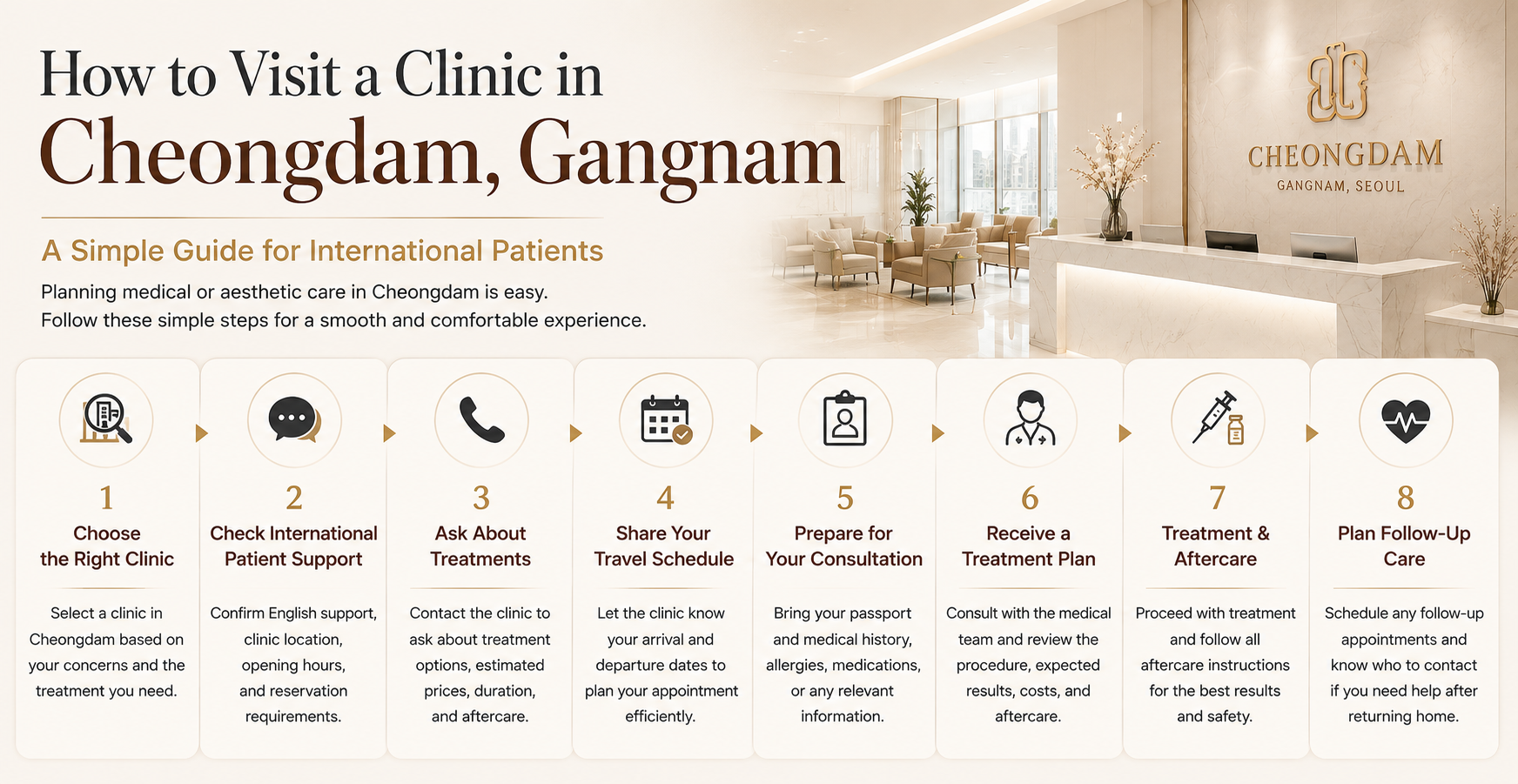
Glass Skin Facial for Foreigners in Seoul, Korea
International residents, expatriates, students, business travelers, and visitors often seek Korean skin treatments while living in or traveling to Seoul.
Foreign patients considering a Glass Skin Facial in Cheongdam or Gangnam may wish to ask:
- What treatments are included?
- Is the facial non-invasive or injectable?
- What exact devices are used?
- Are laser treatments included?
- What products are applied or injected?
- Is the program suitable for my skin type?
- How much downtime should I expect?
- Is English-language consultation available?
- What does the total treatment cost include?
- What aftercare is required?
This makes it easier to compare clinics when “Glass Skin” is used for very different treatment packages.
Choosing a Glass Skin Clinic in Cheongdam
Patients should look beyond promises of instant poreless or translucent skin.
Important considerations include:
- Individual skin assessment
- Clear identification of treatments
- Appropriate products and devices
- Healthcare professional qualifications when medical procedures are involved
- Pigmentation-risk assessment
- Skin barrier condition
- Realistic expectations
- Clear pricing
- Appropriate aftercare
A good consultation should determine whether the patient's concern is dehydration, pigmentation, texture, acne, sensitivity, or another condition before assembling a treatment plan.
Frequently Asked Questions
What is a Glass Skin Facial?
A Glass Skin Facial is a broad Korean aesthetic concept focused on creating smoother, more hydrated, luminous, and even-looking skin through individualized treatments.
Is Glass Skin Facial one specific treatment?
No. The term can describe different combinations of cleansing, exfoliation, hydration, lasers, ultrasound, skin boosters, or other procedures.
What does glass skin mean?
Glass skin refers to skin that appears smooth, hydrated, luminous, clear, and even in tone.
Does a Glass Skin Facial brighten skin?
It may make skin appear brighter by improving hydration, texture, and selected pigmentation. It should not be expected to change a person's natural baseline skin color.
Does Glass Skin Facial hydrate dry skin?
Hydration-focused treatments can improve temporary dryness and skin comfort in selected patients.
Does Glass Skin Facial reduce pores?
Some treatments may make pores appear less noticeable by improving texture, but pores cannot be permanently removed.
Can Glass Skin Facial treat pigmentation?
Selected pigment-focused treatments may be included, but the type of pigmentation should be diagnosed first.
Is Glass Skin Facial good for melasma?
Melasma requires individualized management and should not be treated as ordinary dullness. A Glass Skin program may need to be modified substantially for patients with melasma.
Can Glass Skin Facial treat acne scars?
A basic facial cannot substantially correct deeper structural acne scars. More targeted scar treatments may be required.
Is Glass Skin Facial the same as Hydrafacial?
No. Hydrafacial is a specific branded treatment, while Glass Skin Facial is a broad aesthetic treatment concept.
Is Glass Skin Facial the same as Aqua Peel?
No. Aqua Peel may be one component of a Glass Skin Facial but generally focuses on cleansing, exfoliation, and hydration.
Can Glass Skin Facial include Rejuran?
Some clinics may include Rejuran or other injectable skin treatments in a premium program. Patients should confirm exactly what is included.
Can Glass Skin Facial include laser treatment?
Yes, selected laser treatments may be included depending on pigmentation, texture, and treatment goals.
Is Glass Skin Facial painful?
A basic hydration facial may involve little discomfort, while lasers, microneedling, or injections can be more uncomfortable.
Is there downtime after a Glass Skin Facial?
Downtime depends on the treatments included. Basic facials may have very little downtime, while injections, lasers, peels, or microneedling can cause more visible recovery.
How often should I get a Glass Skin Facial?
Treatment frequency depends on the exact procedures and skin condition. There is no universal schedule.
Is glass skin permanent?
No. Skin changes continuously, and maintenance depends on skincare, sun protection, lifestyle, treatment type, and natural aging.
Can foreigners get a Glass Skin Facial in Korea?
Yes. International residents and visitors can seek Korean skin-rejuvenation treatments at medical clinics and aesthetic facilities. Treatment components, pricing, English-language assistance, and follow-up care vary between providers.
Where can I get a Glass Skin Facial in Cheongdam, Seoul?
Patients interested in Korean glass-skin treatments can consult qualified providers in Cheongdam and the surrounding Gangnam area. A skin assessment can determine which hydration, texture, pigmentation, or skin-quality treatments are appropriate.
Glass Skin Facial Consultation in Cheongdam, Seoul
A Glass Skin Facial may be considered by patients seeking a personalized Korean skin-care approach focused on hydration, smooth texture, radiance, and a more even-looking complexion.
Patients searching for
Glass Skin Facial Cheongdam,
Glass Skin Seoul,
Korean Skin Glow Treatment,
Hydration Facial Gangnam,
K-Beauty Facial Korea,
Korean Skin Rejuvenation Seoul, or
Glass Skin Facial for Foreigners in Korea can consult a qualified provider to discuss the exact treatments included, realistic results, downtime, potential risks, and individualized skin-care planning.