Stem Cell Cheongdam Seoul Clinic
Regenerative Skin Rejuvenation and Anti-Aging Treatment in Korea
Stem cell and cell-based regenerative treatments in Cheongdam, Seoul are specialized medical procedures whose methods, cell sources, processing, regulatory status, and clinical evidence can vary substantially between treatments. Patients considering regenerative skin rejuvenation in Korea should confirm exactly what product or procedure is being offered, whether it is approved or conducted under an appropriate regenerative-medicine framework, its supporting evidence, potential risks, and whether established aesthetic treatments may be more appropriate for their skin concerns.
Stem Cell and Regenerative Skin Treatment in Cheongdam, Seoul
Regenerative medicine is an evolving medical field investigating ways to restore, replace, or support damaged tissues using cells, biological materials, and related technologies.
In aesthetic medicine, terms such as stem cell treatment, cell therapy, regenerative skin treatment, and stem cell anti-aging treatment are sometimes used to describe very different procedures.
These terms should not automatically be treated as interchangeable.
A genuine cell-based treatment should be clearly identified according to the type and source of cells, how they are collected and processed, how they are administered, the intended treatment purpose, and the applicable regulatory framework.
What Is Stem Cell Therapy?
Stem cells are cells with the ability to self-renew and, depending on their type, differentiate into other specialized cell types.
Several categories of stem cells exist, and their biological properties differ considerably.
In medicine, established and investigational stem-cell applications range from hematopoietic stem-cell transplantation to newer regenerative-medicine research involving other cell types.
The existence of stem-cell biology, however, does not mean that every procedure advertised as a “stem cell treatment” has been clinically proven to rejuvenate skin or reverse aging.
Patients should ask what specific cells or biological material are actually being administered.
What Does “Stem Cell Skin Rejuvenation” Mean?
“Stem cell skin rejuvenation” is not one standardized procedure.
Depending on the provider, the term may refer to a cell-based medical procedure, adipose-derived material, conditioned media, extracellular vesicle-related products, cosmetics containing cell-derived ingredients, or other regenerative approaches.
These products and procedures have different biological properties, evidence, risks, and regulatory classifications.
For this reason, patients should not choose a treatment based on the phrase “stem cell” alone.
The exact product and procedure matter considerably more than the marketing category.
Stem Cells vs. Stem Cell-Derived Products
A product described as “stem cell-derived” does not necessarily contain living stem cells.
Some products may contain substances produced or released by cultured cells rather than the cells themselves.
Other treatments may involve processed tissue or isolated cellular components.
These distinctions are medically and legally important.
Patients should ask whether the treatment actually contains living cells and, if so, what type of cells are being used.
Stem Cells vs. Exosomes
Stem cells and exosomes are not the same thing.
Stem cells are living cells.
Exosomes are small extracellular vesicles released by cells and can carry biological molecules between cells.
Although exosome-related technologies are being actively investigated in regenerative medicine, they should not automatically be described as equivalent to stem-cell therapy.
The evidence and regulatory status of a particular exosome product should be evaluated separately.
Stem Cell Treatment vs. PRP
PRP, or platelet-rich plasma, is produced from a patient’s blood and contains concentrated platelets and associated growth factors.
PRP is not a stem-cell treatment.
Stem-cell procedures involve cells or cell-derived technologies with different biological and regulatory considerations.
Patients comparing PRP and regenerative treatments should therefore understand exactly what material is being collected, processed, and administered.
Stem Cell Treatment vs. Skin Boosters
Conventional skin boosters generally involve injectable materials such as hyaluronic acid, polynucleotides, or other specifically formulated products.
These are not stem cells.
Skin boosters and cell-based treatments differ in composition, mechanism, evidence, regulatory status, risks, and treatment goals.
A patient primarily concerned with hydration or fine skin texture may not necessarily require an experimental or complex regenerative procedure.
Stem Cell Treatment vs. Rejuran
Rejuran is a polynucleotide-based injectable treatment and should not be described as stem-cell therapy.
Although both may appear under broad marketing categories such as “regenerative aesthetics,” they are biologically different.
Patients should compare treatments according to their actual composition and clinical evidence rather than broad regenerative terminology.
Stem Cell Treatment vs. Juvelook
Juvelook is an injectable treatment based on PDLLA and hyaluronic acid.
It is not a stem-cell treatment.
Juvelook is commonly discussed in relation to collagen stimulation and skin-quality improvement, whereas genuine stem-cell or cell-based procedures involve an entirely different biological and regulatory framework.
Can Stem Cells Rejuvenate the Skin?
Stem-cell biology and cell-derived signaling are active areas of research in regenerative medicine and dermatology.
Preclinical and clinical research has investigated potential effects involving wound healing, tissue repair, extracellular matrix remodeling, and skin aging.
However, promising biological mechanisms should not be confused with proof that every commercially offered stem-cell procedure safely and reliably rejuvenates human skin.
Clinical evidence depends on the exact cell type, preparation, route of administration, treatment protocol, and patient population.
Can Stem Cells Increase Collagen?
Research into regenerative medicine has investigated interactions between stem cells, fibroblasts, growth factors, extracellular signaling, and collagen production.
However, this does not justify guaranteeing that an unspecified commercial “stem cell treatment” will increase collagen by a particular amount or produce predictable clinical rejuvenation.
Claims should be based on evidence for the exact treatment being offered.
Can Stem Cells Reverse Aging?
No medical aesthetic procedure should be described as reversing the biological aging process.
A treatment may potentially improve selected aspects of skin appearance or tissue quality, but aging involves complex changes throughout the skin and the rest of the body.
Terms such as “reverse aging,” “cellular age reversal,” or “permanent rejuvenation” should therefore be treated cautiously.
The more extraordinary the anti-aging claim, the more important it becomes to ask for evidence involving the exact treatment.
What Skin Concerns Are Studied in Regenerative Aesthetics?
Regenerative approaches have been investigated for concerns involving tissue repair and aspects of skin aging.
Research areas may include:
- Skin texture
- Skin elasticity
- Fine lines
- Photoaging
- Wound healing
- Scarring
- Tissue regeneration
However, investigation does not automatically mean that a treatment is approved or established for each of these purposes.
The level of evidence should be discussed for the exact procedure being considered.
What Are Adipose-Derived Stem Cells?
Adipose tissue contains several cell populations, including cells with regenerative potential.
Adipose-derived stem or stromal cells have therefore received considerable attention in regenerative-medicine research.
Obtaining and processing these cells can involve procedures substantially more complex than conventional aesthetic injections.
How adipose tissue is collected, manipulated, processed, cultured, and administered can affect both the biological characteristics of the resulting material and its regulatory classification.
Patients should receive a clear explanation of each step before treatment.
Are Stem Cells Taken From My Own Body?
Some cell-based procedures use autologous cells, meaning cells obtained from the same patient.
Other regenerative products may involve donor-derived biological material.
Autologous origin does not automatically mean that a treatment is risk-free, proven, or exempt from medical regulation.
Processing, contamination, cell behavior, administration technique, and treatment indication remain important safety considerations.
What Happens During a Stem Cell Consultation?
A consultation should begin by identifying the patient’s actual concern rather than beginning with the assumption that stem cells are required.
The healthcare professional should assess skin condition, medical history, medications, previous aesthetic treatments, allergies, treatment goals, and relevant contraindications.
If a cell-based procedure is proposed, patients should receive clear information about:
- Cell or product type
- Biological source
- Collection method
- Processing method
- Whether cells are cultured or otherwise manipulated
- Route of administration
- Regulatory or clinical-research status
- Supporting clinical evidence
- Expected benefits
- Alternative treatments
- Potential risks
- Follow-up care
This information is particularly important because “stem cell therapy” can refer to very different procedures.
Is Stem Cell Skin Treatment Injectable?
Some regenerative procedures may involve injection, while others may use different methods of administration.
The route should never be assumed from the treatment name alone.
Injection into the skin, intravenous administration, topical application, and other methods are medically distinct and can carry very different risks.
Patients should know exactly how the proposed product will be administered before consenting to treatment.
Are Stem Cell Anti-Aging Treatments Proven?
The answer depends on the exact treatment.
Regenerative medicine contains both established medical therapies and experimental or emerging approaches.
Evidence for one cell type or medical indication cannot simply be transferred to a different cosmetic treatment.
A clinic should be able to identify the exact intervention and explain what human clinical evidence supports its proposed aesthetic use.
Testimonials, before-and-after photographs, laboratory experiments, or studies involving unrelated cell products are not equivalent to evidence for the treatment being offered.
What Are the Risks of Stem Cell Treatment?
Potential risks depend heavily on the type of cells or biological material, processing method, administration route, and treatment area.
Possible risks associated with cell-based or regenerative procedures can include:
- Infection
- Bleeding or injection-related complications
- Inflammatory reactions
- Immune reactions
- Contamination during processing
- Unexpected tissue responses
- Failure to produce the expected result
- Complications related to harvesting cells or tissue
- Risks specific to the route of administration
Certain cell-based therapies may carry additional theoretical or recognized risks related to abnormal cell behavior or unwanted tissue formation.
The exact risk profile should therefore be explained for the specific procedure rather than reduced to the reassuring but meaningless phrase “natural treatment.”
Are Autologous Stem Cells Safer?
Using a patient’s own cells can reduce certain immunological concerns associated with donor-derived material.
However, autologous treatment is not automatically safe.
Collection, processing, manipulation, storage, contamination control, administration technique, and the biological behavior of the final cell preparation remain important.
“From your own body” is a description of origin, not a safety certificate.
How Long Do Stem Cell Skin Rejuvenation Results Last?
There is no scientifically responsible universal answer for an unspecified stem-cell aesthetic procedure.
Duration depends on the exact treatment, patient, indication, biological material, administration technique, and quality of supporting evidence.
Patients should be cautious when a provider guarantees permanent rejuvenation or claims that a single treatment will stop or reverse aging for a fixed period.
How Many Stem Cell Treatments Are Needed?
There is no universal treatment schedule that applies to all procedures marketed as stem-cell rejuvenation.
Treatment frequency should be based on the exact intervention, clinical evidence, applicable regulatory framework, and individual medical assessment.
Repeated cell-based treatment should not be recommended solely because a commercial package includes several sessions.
Is There Downtime After Stem Cell Treatment?
Downtime depends entirely on the procedure.
A treatment involving tissue harvesting may have different recovery requirements from a superficial aesthetic procedure or injection.
Potential swelling, bruising, tenderness, redness, and other reactions also depend on the administration technique and treatment area.
Patients should receive procedure-specific recovery information rather than generic “no downtime” claims.
Who May Not Be Suitable for Regenerative Treatment?
Eligibility depends on the exact intervention.
Medical conditions, active infections, pregnancy, breastfeeding, immune disorders, cancer history, medications, bleeding risks, allergies, and other factors may affect suitability.
Because different cell-based procedures carry different contraindications, patients should undergo individualized medical screening before treatment.
Regenerative Medicine Regulation in Korea
Cell-based therapies and advanced regenerative medicine are regulated medical fields in Korea.
The regulatory pathway can differ depending on whether an intervention involves an approved biological product, clinical research, advanced regenerative medicine, or another category.
Patients should therefore ask the clinic to explain the regulatory status of the exact treatment being offered rather than assuming that availability at a medical clinic automatically means that every claimed aesthetic benefit has been formally approved.
Questions to Ask Before Stem Cell Treatment in Korea
Before undergoing a treatment marketed as stem-cell or regenerative therapy, patients may wish to ask:
- Does this treatment contain living stem cells?
- What type of cells are used?
- Are the cells autologous or donor-derived?
- Where are the cells obtained?
- How are they processed?
- Are they cultured or expanded?
- What exactly is injected or administered?
- What is the regulatory status in Korea?
- What clinical evidence supports this specific use?
- What complications have been reported?
- What alternatives are available?
- What follow-up care is provided?
A clinic should be able to answer these questions clearly.
Stem Cell Treatment for Foreigners in Seoul, Korea
International residents and visitors may encounter regenerative and stem-cell treatments while researching medical and aesthetic care in Seoul.
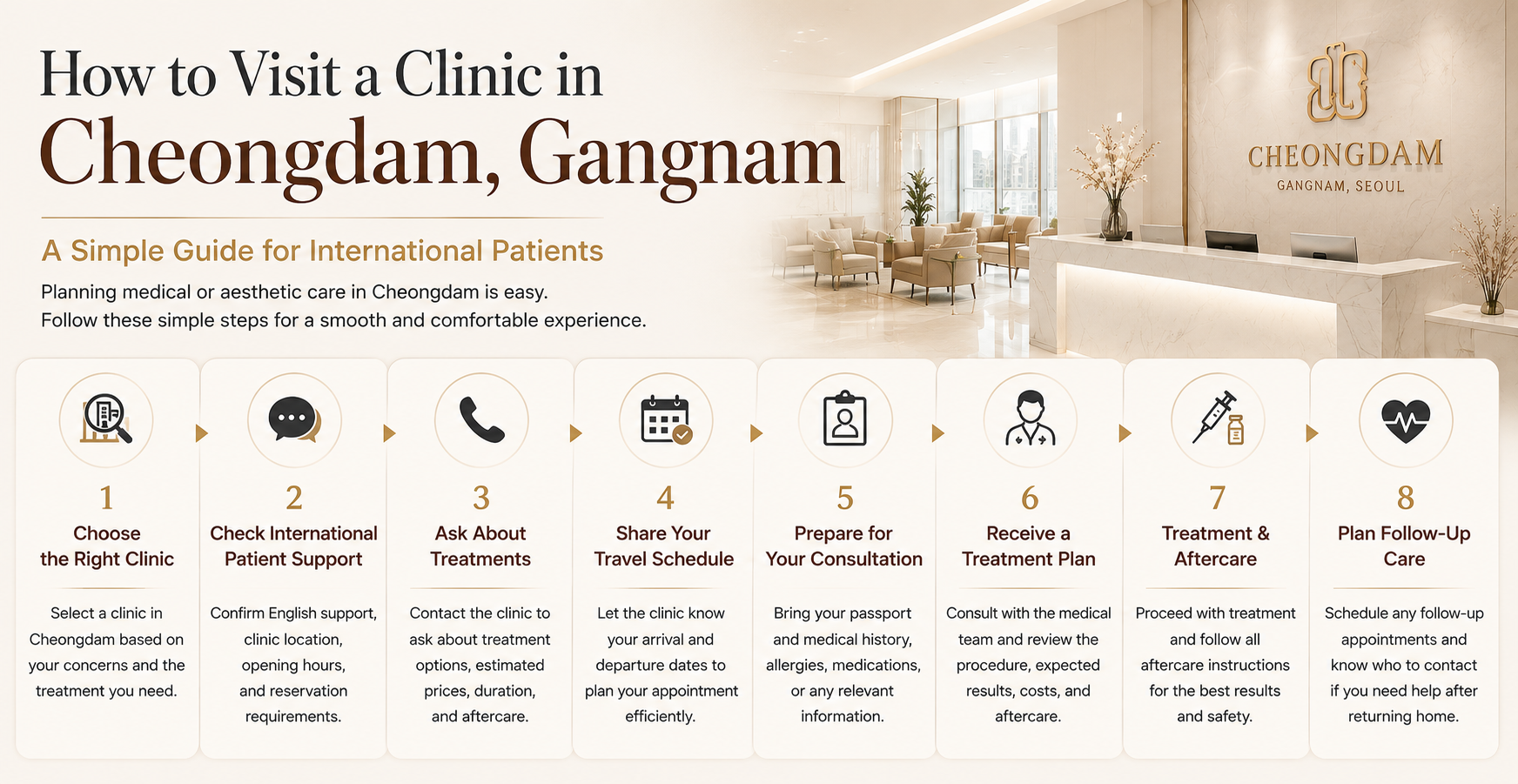
Foreign patients considering treatment in Cheongdam or Gangnam should confirm whether English-language consultation and informed-consent materials are available.
They should also request the exact name and composition of the treatment, source of biological material, processing method, route of administration, Korean regulatory status, clinical evidence, total cost, possible complications, and follow-up arrangements.
This information is particularly important for medical tourists who may leave Korea shortly after treatment.
Choosing a Stem Cell Clinic in Cheongdam
Patients should be cautious about choosing a regenerative treatment based primarily on celebrity endorsements, luxury branding, before-and-after photographs, or dramatic claims about reversing biological age.
Important considerations include the qualifications of the medical team, regulatory status of the procedure, traceability of biological material, processing and quality-control standards, informed consent, clinical evidence, complication management, and follow-up care.
A credible provider should also be willing to explain the limitations of the treatment.
If one mysterious vial allegedly fixes wrinkles, hair loss, fatigue, immunity, joints, metabolism, and aging at once, the marketing department has probably achieved rather more than the clinical evidence has.
Frequently Asked Questions
What is stem cell skin rejuvenation?
Stem cell skin rejuvenation is a broad term used for various cell-based or regenerative approaches proposed for skin-related aesthetic goals. It is not one standardized treatment, so the exact cells, product, processing method, evidence, and regulatory status should be identified.
Are stem cells proven to reverse skin aging?
Research into stem cells and regenerative biology is ongoing, but no unspecified stem-cell treatment should be assumed to reverse biological aging. Evidence must be evaluated for the exact treatment and indication.
Do stem cells increase collagen?
Stem-cell and regenerative-medicine research has investigated pathways involving fibroblasts, extracellular matrix, and collagen. This does not guarantee clinically meaningful collagen improvement from every commercial treatment marketed as stem-cell therapy.
Are exosomes stem cells?
No. Exosomes are extracellular vesicles released by cells and are not living stem cells.
Is PRP a stem cell treatment?
No. PRP is produced from blood and contains concentrated platelets and associated factors. It is not stem-cell therapy.
Is Rejuran a stem cell treatment?
No. Rejuran is a polynucleotide-based injectable treatment.
Is Juvelook a stem cell treatment?
No. Juvelook contains PDLLA and hyaluronic acid and is not a stem-cell product.
Are stem cells from my own body completely safe?
No. Autologous origin does not eliminate risks related to harvesting, processing, contamination, administration, or unexpected biological effects.
Are stem cell treatments approved in Korea?
Korea has a regulatory framework governing cell therapies and advanced regenerative medicine. Whether a particular treatment is approved or permitted depends on the exact product, procedure, indication, and regulatory pathway.
How long do stem cell anti-aging results last?
There is no universal evidence-based duration for treatments broadly marketed as stem-cell anti-aging therapy. Duration claims should be supported by clinical evidence for the exact intervention.
Can foreigners receive regenerative treatments in Korea?
Treatment availability depends on the specific procedure and its regulatory status. International patients should confirm the exact intervention, eligibility, informed-consent process, follow-up plan, and Korean regulatory status before treatment.
Where can I get stem cell treatment in Cheongdam, Seoul?
Patients interested in regenerative medicine can consult appropriately qualified medical institutions in Seoul. Before undergoing treatment, they should verify exactly what cell or biological product is being offered, its regulatory status, supporting evidence, risks, and available alternatives.
Stem Cell Consultation in Cheongdam, Seoul
Patients interested in regenerative skin rejuvenation should begin with a medical assessment and a precise explanation of the proposed treatment rather than relying on the broad label “stem cell therapy.”
Patients searching for
Stem Cell Cheongdam,
Stem Cell Seoul,
Regenerative Skin Treatment Korea,
Stem Cell Anti-Aging Korea,
Regenerative Medicine Seoul, or
Stem Cell Treatment for Foreigners in Korea should confirm the exact biological material, regulatory status, clinical evidence, potential risks, alternatives, and follow-up plan before deciding whether treatment is appropriate.