Vasectomy Cheongdam Seoul Clinic
Male Sterilization and Family Planning Procedure in Korea
Vasectomy in Cheongdam, Seoul is a permanent male contraception procedure that blocks or divides the vas deferens so sperm no longer enter the semen after successful treatment and follow-up confirmation. Patients considering vasectomy in Korea should understand that it is intended as permanent contraception, does not provide immediate sterility, requires post-vasectomy semen analysis before stopping alternative contraception, and carries potential risks such as bruising, infection, sperm granuloma, and persistent scrotal pain.
Vasectomy in Cheongdam, Seoul
A vasectomy is a minor surgical procedure used for permanent male contraception.
During the procedure, the vas deferens, the tubes that carry sperm from the testicles toward the urethra, are divided, sealed, blocked, or otherwise interrupted.
After a successful vasectomy, sperm continue to be produced by the testicles but no longer enter the ejaculated semen in clinically significant amounts once residual sperm have cleared.
The procedure does not remove the testicles and does not stop the production of testosterone.
What Is a Vasectomy?
A vasectomy is a form of male sterilization intended for people who do not want biological children in the future or who believe their family is complete.
The procedure interrupts both vas deferens.
Semen is still ejaculated after treatment because sperm make up only a small portion of ejaculate volume.
The major fluids in semen continue to be produced by the prostate and seminal vesicles.
Is Vasectomy Permanent?
Vasectomy should be approached as a permanent method of contraception.
Vasectomy reversal surgery is possible in selected cases, but successful restoration of fertility cannot be guaranteed.
The likelihood of successful reversal can also depend on how much time has passed since vasectomy, surgical technique, reproductive health, and other factors.
Patients who are uncertain about future fertility should consider this carefully before undergoing the procedure.
How Does a Vasectomy Work?
Sperm are produced in the testicles and travel through the epididymis and vas deferens.
During vasectomy, each vas deferens is interrupted.
This prevents sperm from reaching the semen during ejaculation once sperm remaining downstream from the procedure have cleared.
The body continues producing sperm, which are subsequently broken down and absorbed.
Does Vasectomy Stop Ejaculation?
No.
Men continue to ejaculate after vasectomy.
Most of the fluid in semen does not originate from the testicles or vas deferens.
Because only the sperm component is removed from the ejaculate, the visible amount of semen generally changes very little.
Does Vasectomy Affect Testosterone?
Vasectomy does not remove or directly damage the testicles.
Testosterone production therefore continues.
The procedure does not intentionally alter male hormone production.
Does Vasectomy Affect Sex Drive?
Vasectomy does not directly reduce testosterone or sexual desire.
Libido is influenced by many psychological, hormonal, medical, and relationship factors, but blocking the vas deferens does not itself remove the hormonal mechanisms responsible for sexual desire.
Does Vasectomy Affect Erections?
A vasectomy does not directly interfere with the nerves or blood vessels responsible for erection.
It is therefore not intended to cause erectile dysfunction.
Patients experiencing erectile problems after a procedure should be evaluated for other causes rather than assuming that sperm transport and erectile function are the same physiological system.
Does Vasectomy Affect Orgasm?
Orgasm should generally remain possible after vasectomy.
The nerves and muscular processes responsible for orgasm are not intentionally altered.
The sensation of ejaculation is also generally preserved.
Does Semen Look Different After Vasectomy?
Usually not significantly.
Sperm represent only a small proportion of semen volume.
Most patients therefore do not notice a major visible change in their ejaculate.
A microscope, annoyingly, is considerably more discriminating than the naked eye. This is why semen analysis exists.
Is Vasectomy Effective?
Vasectomy is one of the most effective forms of permanent contraception.
However, it is not 100% effective.
Even after post-vasectomy testing confirms successful occlusion, pregnancy can very rarely occur because of recanalization or other failure.
Patients should understand both the very high effectiveness and the small residual possibility of failure.
Does Vasectomy Work Immediately?
No.
This is one of the most important points about vasectomy.
Sperm can remain in the reproductive tract beyond the site where the vas deferens were interrupted.
These residual sperm may still be capable of fertilization.
Patients must continue using another form of contraception until post-vasectomy semen testing confirms that the procedure has achieved the appropriate endpoint.
What Is Post-Vasectomy Semen Analysis?
Post-vasectomy semen analysis, often abbreviated PVSA, is laboratory testing performed after vasectomy.
A semen sample is examined to determine whether sperm remain.
The result helps determine whether the patient can begin relying on vasectomy for contraception.
Patients should follow the clinic's instructions regarding:
- When to provide the sample
- How to collect it
- How quickly it must reach the laboratory
- Whether repeat testing is needed
- When alternative contraception can safely be discontinued
When Can I Stop Using Other Birth Control After Vasectomy?
Only after the treating healthcare professional confirms that the appropriate post-vasectomy semen-analysis criteria have been met.
Patients should not stop contraception simply because several weeks have passed or because they have ejaculated a particular number of times.
Time and ejaculation help clear residual sperm, but laboratory confirmation is what determines whether vasectomy can be relied upon.
What Is a No-Scalpel Vasectomy?
A no-scalpel vasectomy is a technique used to access the vas deferens through a small puncture or opening in the scrotal skin rather than a larger conventional incision.
The vas deferens must still be interrupted or occluded.
“No-scalpel” describes the access technique rather than some mysterious version in which the operation somehow occurs without surgical manipulation.
Potential advantages can include a smaller skin opening and reduced tissue disruption.
No-Scalpel Vasectomy vs. Conventional Vasectomy
Both procedures have the same basic purpose: interrupting sperm transport through the vas deferens.
The main difference is how the surgeon accesses the vas.
A conventional approach may use small incisions.
A no-scalpel technique uses a small puncture-style opening.
The method used to occlude the vas deferens can also vary.
Patients should ask what surgical technique their doctor uses and why.
What Happens During a Vasectomy?
The exact procedure varies, but a typical vasectomy may involve:
- Cleaning and preparing the scrotal area.
- Administering local anesthesia.
- Locating each vas deferens.
- Accessing the vas through a small opening.
- Dividing or removing a small segment.
- Sealing, cauterizing, clipping, ligating, or otherwise occluding the vas according to the surgeon's technique.
- Closing the opening if necessary.
The procedure is generally performed on an outpatient basis.
Is Vasectomy Performed Under Local Anesthesia?
Many vasectomies are performed using local anesthesia.
The anesthetic numbs the treatment area while the patient remains awake.
Sedation or another anesthetic approach may occasionally be used depending on individual circumstances and clinic protocol.
Is Vasectomy Painful?
Patients may feel the injection of local anesthetic and some pulling, pressure, or manipulation during the procedure.
Sharp pain should not be expected once adequate anesthesia has taken effect.
Afterward, temporary soreness, tenderness, or aching can occur.
How Long Does Vasectomy Take?
The actual surgical procedure is generally relatively brief.
However, total appointment time includes consultation, preparation, anesthesia, surgery, and post-procedure instructions.
The exact duration depends on anatomy and surgical technique.
What Happens After a Vasectomy?
After treatment, patients may experience:
- Scrotal soreness
- Mild swelling
- Bruising
- Tenderness
- Mild discomfort around the incision or puncture site
Supportive underwear and cold packs may be recommended according to the surgeon's instructions.
Patients should follow clinic-specific guidance on physical activity, bathing, exercise, sexual activity, and wound care.
How Long Is Vasectomy Recovery?
Many patients return to light daily activities relatively quickly.
More strenuous exercise, heavy lifting, cycling, or physically demanding work may need to be avoided temporarily.
Recovery depends on the surgical technique, occupation, individual healing, and whether complications occur.
When Can I Have Sex After Vasectomy?
Patients should follow the treating doctor's instructions regarding when sexual activity can resume.
Temporary soreness should be allowed to settle.
Importantly, resuming sex does not mean the vasectomy is already contraceptively effective.
Another method of birth control must continue until semen testing confirms success.
Can I Exercise After Vasectomy?
Strenuous exercise and heavy lifting are usually restricted during the early recovery period.
Exercise too soon may worsen discomfort, bruising, or swelling.
The appropriate interval depends on recovery and the surgeon's instructions.
Can I Shower After Vasectomy?
Instructions vary according to wound closure and surgical technique.
Patients should follow the clinic's advice about showering, bathing, swimming, and wound care.
Keeping the area clean and monitoring for signs of infection are important.
What Are the Common Side Effects of Vasectomy?
Common temporary effects can include:
- Pain
- Tenderness
- Bruising
- Swelling
- Minor bleeding
- Temporary discomfort
Most improve as the area heals.
Can Vasectomy Cause Infection?
Yes.
Like other surgical procedures, vasectomy carries a risk of wound or local infection.
Patients should seek medical assessment for symptoms such as:
- Increasing redness
- Worsening swelling
- Pus or drainage
- Fever
- Increasing pain
- Significant warmth around the wound
Infections may require antibiotic treatment.
What Is a Sperm Granuloma?
A sperm granuloma is a small lump that can develop when sperm leak from the cut end of the vas deferens and cause a localized inflammatory reaction.
Many sperm granulomas are small and do not cause significant problems.
Some can cause tenderness or discomfort.
A persistent or painful lump should be medically evaluated.
Can Vasectomy Cause Long-Term Testicular Pain?
Persistent scrotal or testicular pain can occur after vasectomy in a minority of patients.
This is sometimes described as post-vasectomy pain syndrome, or PVPS.
Symptoms vary from mild aching to more disruptive chronic pain.
Treatment may include medication and other approaches, with surgery considered in selected severe cases.
Can Vasectomy Fail?
Yes, although failure is uncommon.
Potential reasons include:
- Early technical failure
- Persistent sperm in semen
- Recanalization of the vas deferens
- Rare late reconnection after an initially successful procedure
This is another reason post-vasectomy semen testing is essential.
Can the Vas Deferens Reconnect?
Rarely, the divided ends can reconnect, a process known as recanalization.
This can lead to persistent sperm or, rarely, return of fertility.
Recanalization can occur early or, much less commonly, after an initially successful semen test.
What Happens If Sperm Are Still Present After Vasectomy?
Management depends on whether sperm are motile, their concentration, how long it has been since surgery, and the clinic's protocol.
Additional semen testing may be required.
Persistent evidence of unsuccessful occlusion may occasionally require repeat vasectomy.
Patients should not assume the procedure has failed or succeeded without clinical interpretation of the test.
Can Pregnancy Occur After a Successful Vasectomy?
Rarely.
Even after semen analysis confirms successful vas occlusion, pregnancy is not impossible.
The AUA guideline estimates pregnancy risk after confirmed azoospermia at roughly 1 in 2,000.
For practical family planning, vasectomy is extremely effective, but biology has apparently refused to provide a literal zero-percent failure rate.
Does Vasectomy Protect Against STIs?
No.
Vasectomy prevents pregnancy by blocking sperm transport.
It does not protect against sexually transmitted infections such as:
- HIV
- Gonorrhea
- Chlamydia
- Syphilis
- HPV
- Herpes
Condoms or other appropriate protective measures remain important when STI prevention is needed.
Vasectomy vs. Condoms
Condoms provide reversible contraception and can reduce transmission risk for many sexually transmitted infections.
Vasectomy provides highly effective permanent contraception but no STI protection.
They therefore serve different purposes.
Vasectomy vs. Female Sterilization
Both are permanent contraception methods.
Female sterilization generally involves procedures affecting the fallopian tubes and may require abdominal or laparoscopic surgery.
Vasectomy is performed on the vas deferens through the scrotal area and is generally less invasive.
Couples considering permanent contraception may wish to discuss both options.
Vasectomy vs. Birth Control Pills
Birth control pills are reversible hormonal contraception used by women.
Vasectomy is a permanent male surgical contraception method.
Vasectomy removes the ongoing need for contraception for pregnancy prevention after successful confirmation, but only when the decision for permanent fertility control is appropriate.
Vasectomy vs. IUD
An intrauterine device is a long-acting but reversible contraceptive option.
Vasectomy is intended to be permanent.
For couples who may want future pregnancy, a reversible method may therefore be more appropriate.
Can Vasectomy Be Reversed?
Vasectomy reversal surgery can sometimes reconnect the vas deferens.
Procedures may include vasovasostomy or, when necessary, more complex reconstruction.
Success depends on several factors and should never be guaranteed.
Pregnancy after technically successful reversal also depends on fertility factors involving both partners.
Should I Have a Vasectomy If I Might Want Children Later?
Vasectomy is generally not ideal when there is meaningful uncertainty about future biological children.
Reversal is not guaranteed.
Patients uncertain about permanent sterilization may wish to consider reversible contraception instead.
Sperm cryopreservation may also be discussed before surgery in selected cases.
Can I Freeze Sperm Before Vasectomy?
Yes, sperm cryopreservation can be considered before vasectomy for patients who want to preserve a potential future reproductive option.
Stored sperm may later be used with assisted reproductive technologies.
Storage involves separate costs and ongoing arrangements with an appropriate fertility or sperm-banking facility.
Does Vasectomy Increase Prostate Cancer Risk?
Current major medical guidance does not consider vasectomy a proven cause of prostate cancer.
Patients with prostate-health concerns should follow standard age- and risk-appropriate medical screening recommendations independently of their vasectomy decision.
Does Vasectomy Affect Urination?
Vasectomy does not involve the bladder, urethra, or prostate in a way intended to alter urinary flow.
Urination should therefore generally remain unchanged.
New urinary symptoms should be evaluated separately.
Does Vasectomy Change the Testicles?
The testicles remain in place and continue producing testosterone and sperm.
Sperm are no longer transported through the vas deferens into the semen.
They are instead broken down and absorbed by the body.
Who Is a Good Candidate for Vasectomy?
Vasectomy may be appropriate for adults who:
- Are certain they do not want biological children in the future
- Consider their family complete
- Want a highly effective permanent contraceptive method
- Understand that reversal cannot be guaranteed
- Understand the need for follow-up semen testing
The decision should be voluntary and well considered.
Who Should Think Carefully Before Vasectomy?
Patients may wish to delay the procedure if they:
- Are uncertain about future children
- Are making the decision during a temporary relationship crisis
- Feel pressured by a partner or family
- Assume reversal is simple or guaranteed
- Have not considered reversible alternatives
Permanent contraception deserves slightly more thought than choosing the cheapest appointment slot on a clinic menu.
Vasectomy Consultation in Korea
A preoperative consultation should review:
- Reproductive goals
- Medical history
- Current medications
- Allergies
- Previous scrotal or inguinal surgery
- Bleeding risk
- Genital examination when appropriate
- Surgical technique
- Risks and complications
- Recovery
- Semen-analysis follow-up
- Alternatives to permanent sterilization
Patients should have an opportunity to ask questions before giving informed consent.
Family Planning and Vasectomy
Vasectomy can be an important family-planning option for individuals or couples who are confident that they do not want future pregnancies.
The decision does not need to be based solely on whether someone already has children.
What matters is informed and voluntary decision-making with a clear understanding of permanence.
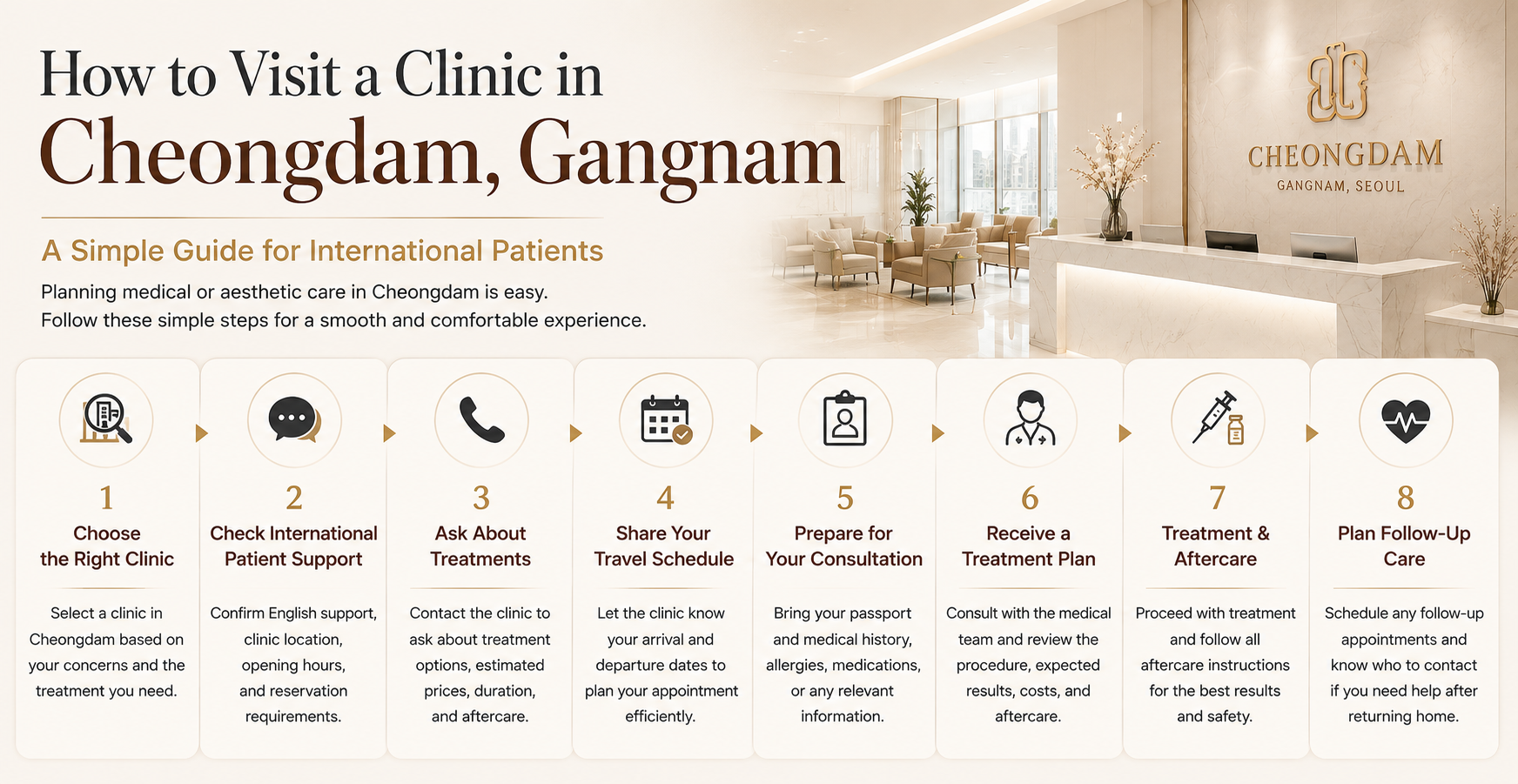
Vasectomy for Foreigners in Seoul, Korea
International residents, expatriates, students, business travelers, and other foreign patients may seek vasectomy in Seoul.
Foreign patients considering vasectomy in Cheongdam or Gangnam may wish to ask:
- Is English-language consultation available?
- What vasectomy technique is used?
- Is the procedure no-scalpel?
- What anesthesia is used?
- How much recovery time is expected?
- When should semen analysis be performed?
- Where can post-vasectomy semen testing be completed?
- What happens if I leave Korea before follow-up testing?
- What complications require urgent medical care?
- What does the total price include?
Follow-up planning is particularly important for patients who may leave Korea soon after surgery.
Traveling After Vasectomy in Korea
Patients traveling internationally should consider recovery and follow-up before scheduling vasectomy near the end of a trip.
Long flights, luggage lifting, prolonged sitting, and limited access to the treating clinic can complicate early recovery.
Patients should also arrange a reliable method for post-vasectomy semen analysis.
A vasectomy performed on the final morning before an airport sprint is, medically speaking, an unnecessarily ambitious itinerary.
Choosing a Vasectomy Clinic in Cheongdam
Patients considering vasectomy should look beyond price alone.
Important considerations include:
- Qualified medical care
- Experience performing vasectomy
- Clear explanation of surgical technique
- Sterile procedure standards
- Pain-management approach
- Postoperative instructions
- Access to semen analysis
- Management of complications
- English-language communication where required
- Clear follow-up arrangements
A vasectomy appointment is not complete when the incision heals. Confirmation of contraceptive success is part of the treatment process.
Frequently Asked Questions
What is a vasectomy?
A vasectomy is a permanent male contraception procedure that interrupts the vas deferens so sperm no longer enter the semen after successful treatment and sperm clearance.
Is vasectomy permanent?
It should be considered permanent. Reversal is possible in selected cases but cannot be guaranteed to restore fertility.
How effective is vasectomy?
Vasectomy is more than 99% effective as a permanent contraception method after successful follow-up confirmation.
Does vasectomy work immediately?
No. Residual sperm remain after surgery, so another contraceptive method must be used until semen analysis confirms successful occlusion.
What is a post-vasectomy semen test?
It is a laboratory analysis used to determine whether sperm remain in the semen after surgery.
Can I stop contraception after a certain number of ejaculations?
Not simply based on ejaculation count. Patients should wait until their healthcare professional confirms satisfactory post-vasectomy semen-analysis results.
Does vasectomy affect testosterone?
No. The testicles continue producing testosterone.
Does vasectomy affect erections?
Vasectomy does not directly interfere with the physiological mechanisms responsible for erections.
Does vasectomy affect ejaculation?
Ejaculation continues. Semen volume usually changes very little because sperm form only a small part of the ejaculate.
Does vasectomy reduce sexual pleasure?
Vasectomy does not intentionally alter orgasm, libido, testosterone, or erectile function.
Is no-scalpel vasectomy different?
No-scalpel vasectomy uses a small puncture-style opening to access the vas deferens instead of a larger conventional incision. The vas still needs to be surgically interrupted.
Does vasectomy hurt?
Local anesthesia is commonly used. Temporary soreness, bruising, or swelling can occur afterward.
How long is vasectomy recovery?
Many patients return to light activity relatively quickly, while heavy lifting and strenuous exercise may need to be avoided temporarily.
Can vasectomy fail?
Yes, but failure is uncommon. Persistent sperm or rare recanalization can occur.
Can pregnancy happen after vasectomy?
Rarely. Pregnancy risk remains very small even after successful post-vasectomy testing.
Does vasectomy protect against STIs?
No. Vasectomy provides contraception but no protection against sexually transmitted infections.
Can vasectomy be reversed?
Reversal surgery is possible in selected patients, but successful fertility restoration cannot be guaranteed.
Should I freeze sperm before vasectomy?
Sperm cryopreservation may be considered if a patient wants to preserve a potential future reproductive option despite choosing vasectomy.
Can foreigners get a vasectomy in Korea?
Foreign patients can consult medical institutions in Korea regarding vasectomy. Availability, surgical techniques, pricing, English-language assistance, and post-vasectomy semen-testing arrangements vary by clinic.
Where can I get a vasectomy in Cheongdam, Seoul?
Patients considering vasectomy can consult qualified medical professionals in Cheongdam and the surrounding Gangnam area. A consultation can review permanent contraception goals, surgical technique, recovery, possible complications, and the required post-vasectomy semen-analysis plan.
Vasectomy Consultation in Cheongdam, Seoul
Vasectomy may be considered by adults seeking highly effective permanent contraception after careful consideration of future fertility goals.
Patients searching for Vasectomy Cheongdam, Vasectomy Seoul, Male Sterilization Korea, No-Scalpel Vasectomy Gangnam, Permanent Male Contraception Seoul, Family Planning Korea, or Vasectomy for Foreigners in Seoul can consult a qualified healthcare professional to discuss surgical technique, expected recovery, potential risks, alternatives, and post-vasectomy semen testing before making an informed decision.