Thermage vs Ultherapy in Cheongdam
Thermage vs Ultherapy in Cheongdam
Choosing between Thermage and Ultherapy in Cheongdam can be difficult because both are well-known non-surgical treatments for skin tightening and facial rejuvenation. They are designed to stimulate changes beneath the skin without traditional surgery, but they use different types of energy and are not identical treatments.
Thermage FLX uses radiofrequency (RF) energy, while Ultherapy uses focused ultrasound energy. The U.S. FDA records Thermage FLX as an RF-based system, while the Ulthera system is classified as focused ultrasound.
Neither treatment is automatically better for everyone. The right choice depends on the type and degree of laxity, treatment area, facial anatomy, skin condition, desired outcome, tolerance for discomfort, and whether the primary concern is firmness, contour, or another aspect of facial aging.
Thermage vs Ultherapy: At a Glance
FeatureThermage FLXUltherapyEnergyRadiofrequencyFocused ultrasoundMain purposeSkin tightening and firmnessLifting and tightening selected lax tissueTreatment approachRF heating of tissueFocused ultrasound energy at targeted depthsCommon concernsFine lines, laxity, skin firmnessMild to moderate laxity and contourCommon areasFace, jawline, selected neck areasBrow, lower face, under-chin and neck areasDowntimeUsually limitedUsually limitedResultsGradualGradualSurgery requiredNoNoRemoves excess skinNoNo
The American Academy of Dermatology notes that non-invasive ultrasound and radiofrequency treatments can stimulate collagen and produce gradual tightening, although results are more modest than surgical lifting.
What Is Thermage FLX?
Thermage FLX is a non-invasive radiofrequency treatment. The FDA's device documentation describes the system as delivering RF energy while incorporating cooling of the epidermis.
The goal is to heat tissue in a controlled manner and stimulate changes associated with collagen remodeling.
Thermage may be considered when the main concerns include:
- Mild skin laxity
- Reduced firmness
- Fine lines
- Early jawline softening
- Certain facial contour concerns
- Skin aging in selected areas
One potential advantage of RF treatment is that it can provide a broader heating effect rather than concentrating ultrasound energy at individual focal points.
What Is Ultherapy?
Ultherapy uses focused ultrasound energy to create controlled thermal effects beneath the skin. The Ulthera system also incorporates ultrasound imaging to help visualize the treatment area and guide energy delivery.
It may be considered for selected areas affected by laxity, including:
- Brow region
- Lower face
- Jawline
- Under the chin
- Neck
Ultherapy is particularly associated with non-surgical lifting and tightening rather than simply improving surface skin quality.
How Do Thermage and Ultherapy Work Differently?
Thermage: Radiofrequency Energy
Thermage uses RF energy to heat tissue beneath the skin. The treatment is designed to encourage collagen-related remodeling over time.
The AAD explains that radiofrequency skin tightening can produce some immediate feeling of tightening, while more significant improvement develops gradually as the body produces new collagen.
Ultherapy: Focused Ultrasound
Ultherapy uses focused acoustic energy at selected depths. Its ultrasound imaging capability can help the operator visualize tissue during treatment.
The AAD notes that ultrasound tightening can produce modest lifting and tightening, with improvement generally developing over a period of months.
The difference is therefore not simply "which machine is stronger." The technologies deliver energy differently and may be selected for different treatment goals.
Which Is Better for Skin Tightening?
Both can be considered for skin tightening, but the ideal choice depends on the patient's specific concern.
Thermage may be attractive when the objective is primarily:
- Overall firmness
- Mild laxity
- Fine lines
- General skin tightening
- Gradual improvement in skin quality and contour
Ultherapy may be considered when the treatment plan is more focused on:
- Mild to moderate tissue laxity
- Lower-face lifting
- Jawline definition
- Under-chin laxity
- Selected neck concerns
However, these categories overlap. A qualified provider may recommend either technology depending on facial anatomy and treatment goals.
Thermage vs Ultherapy for the Jawline
A softer jawline can have several causes, including skin laxity, facial fat, volume loss, muscle anatomy, chin projection, and changes in underlying facial structures.
If laxity is a significant contributor, either Thermage or Ultherapy may be considered.
Ultherapy may be particularly relevant when the treatment objective involves lifting lax tissue in the lower face or under the chin. Thermage may be considered when overall firmness and skin tightening are the main goals.
Neither procedure should be expected to dramatically reshape a jawline when the main cause is excess fat, significant structural volume loss, or substantial excess skin.
Thermage vs Ultherapy for the Neck
The neck can develop laxity, fine lines, and reduced elasticity with age.
Both treatments can be used as non-surgical options in appropriately selected patients, but the treatment strategy should be individualized.
Ultherapy has established use in focused ultrasound treatment of lax submental and neck tissue, while Thermage uses RF energy for controlled tissue heating.
For significant neck skin excess, however, neither technology can reproduce the skin removal and structural repositioning available through a surgical neck lift.
Which Treatment Is Better for Fine Lines?
Fine lines can have different causes.
Some are primarily related to repeated muscle movement and may respond better to botulinum toxin. Others are associated with skin quality, collagen loss, sun exposure, or reduced elasticity.
Thermage may be considered when reduced firmness and skin quality contribute to fine lines. Ultherapy can also be used when laxity is an important part of the aging pattern.
For sun-related wrinkles or pigmentation, other dermatologic treatments may be more appropriate. The AAD lists options including Botox, fillers, chemical peels, microdermabrasion, and laser treatments depending on the specific concern.
Treatment Experience and Discomfort
Neither Thermage nor Ultherapy is completely sensation-free.
During treatment, patients may experience:
- Heat
- Tingling
- Pressure
- Brief pulses of discomfort
- Tenderness afterward
The experience can vary significantly between patients and treatment areas.
Pain tolerance, treatment settings, treatment coverage, and individual sensitivity can all influence the experience. Patients should discuss comfort-management options with the clinic before treatment.
Downtime and Recovery
One of the main reasons international patients consider non-surgical lifting is the relatively limited recovery compared with surgery.
Temporary effects can include:
- Redness
- Swelling
- Tenderness
- Sensitivity
- Temporary discomfort
The amount and duration of these effects vary.
The absence of major surgical downtime does not mean that every patient will look completely unchanged immediately afterward. If you are visiting Seoul for a wedding, photoshoot, business event, or other important occasion, leave enough time between treatment and the event.
When Do Results Appear?
Both Thermage and Ultherapy are associated with gradual results rather than an immediate surgical-style lift.
The AAD reports that ultrasound skin tightening commonly produces modest lifting and tightening over approximately two to six months, while radiofrequency tightening may continue improving as collagen develops, with best results around six months for many patients. Individual results vary.
This means expectations should be realistic.
A treatment may gradually make the skin appear firmer or the contour more defined, but it cannot stop the natural aging process.
Thermage vs Ultherapy: Which One Lasts Longer?
There is no single guaranteed duration that applies to every patient.
The longevity of results can depend on:
- Age
- Degree of skin laxity
- Skin quality
- Treatment parameters
- Lifestyle
- Sun exposure
- Weight changes
- Natural aging
- Individual collagen response
The AAD notes that results from non-invasive tightening can last for years in some patients, but ongoing skin care and additional treatments may be needed to maintain improvement.
A clinic should avoid promising a fixed duration of results for every patient.
Can You Combine Thermage and Ultherapy?
Some aesthetic treatment plans may combine different technologies, but combining treatments is not automatically better.
The decision should be based on:
- Treatment objectives
- Facial anatomy
- Previous procedures
- Skin condition
- Treatment timing
- Expected cumulative effects
- Recovery considerations
Patients should ask why two technologies are being recommended and what additional benefit the combination is expected to provide.
More procedures also mean more cost and potentially more side effects, so combination treatment should have a clear clinical rationale.
Thermage vs Ultherapy in Cheongdam: Cost Factors
There is no universal price for Thermage or Ultherapy in Cheongdam.
Treatment cost can vary according to:
- Device and treatment type
- Treatment area
- Number of shots or treatment lines
- Treatment coverage
- Provider
- Clinic
- Whether multiple areas are treated
- Whether other procedures are included
International patients should also account for consultation fees, transportation, accommodation, and possible follow-up visits.
When comparing Cheongdam clinics, it is useful to compare the actual treatment plan, not just the advertised headline price. A lower price may represent fewer treatment lines, a smaller treatment area, or a different protocol.
How to Choose Between Thermage and Ultherapy
A consultation should begin with the question: What is causing the visible aging concern?
Consider Thermage when your primary goal is:
- Overall skin firmness
- Mild laxity
- Fine-line improvement
- General tightening
- Gradual collagen remodeling
Consider Ultherapy when your primary goal is:
- Lifting lax tissue
- Improving lower-face contour
- Jawline definition
- Under-chin tightening
- Selected neck lifting
These are general considerations rather than strict rules. A medical professional should determine which technology is appropriate for your facial structure.
When Neither Thermage nor Ultherapy Is the Best Option
Sometimes the best answer is another treatment.
For example:
- Expression wrinkles: Botox may be more appropriate.
- Volume loss: Dermal filler may be considered.
- Pigmentation: Laser or light-based treatment may be more relevant.
- Poor skin texture: Resurfacing or other skin-quality treatments may be considered.
- Excess facial fat: A fat-reduction strategy may be needed.
- Significant loose skin: Surgical lifting may provide more substantial correction.
The AAD specifically notes that ultrasound and non-invasive RF can tighten loose skin, but non-surgical treatments cannot provide the same results as procedures such as a facelift, eyelid surgery, or neck lift.
Choosing a Clinic in Cheongdam
For international patients, choosing the provider is at least as important as choosing the device.
Before treatment, consider:
- Whether a qualified medical professional performs or supervises the procedure
- Whether your facial anatomy is assessed
- Whether the clinic explains realistic outcomes
- Whether the treatment device is clearly identified
- Whether treatment parameters are individualized
- Whether risks and side effects are explained
- Whether aftercare instructions are provided
- Whether English-language communication is available if needed
Avoid selecting a clinic solely because it offers the largest number of shots or the lowest advertised price.
Planning Your Treatment as an International Patient
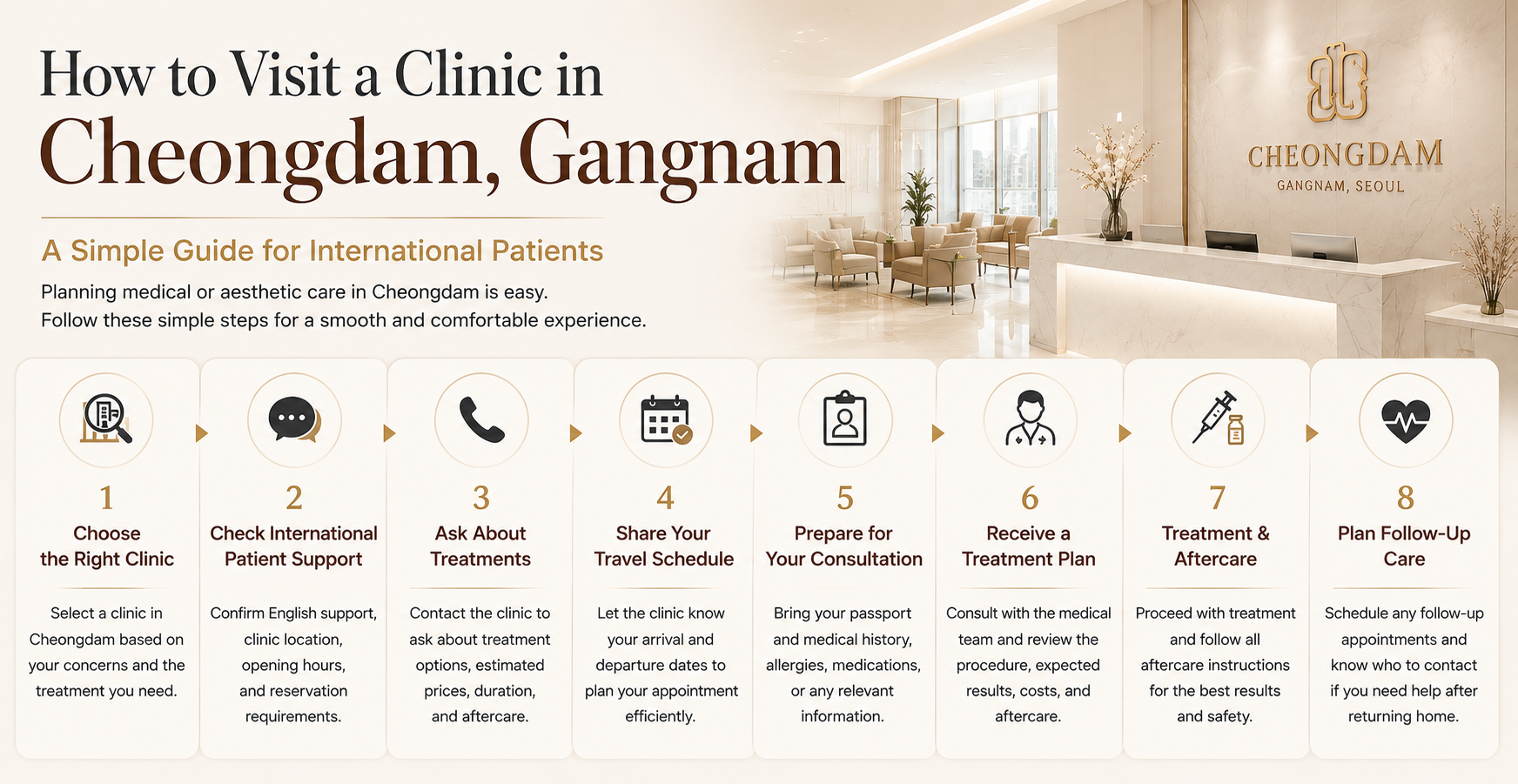
If you are traveling to Seoul specifically for aesthetic treatment, build your itinerary around the procedure.
Before arriving in Cheongdam:
- Research clinics and treatment providers.
- Share your relevant medical and cosmetic treatment history.
- Ask whether a consultation can be arranged before treatment.
- Confirm the expected treatment area.
- Ask about discomfort and recovery.
- Leave time for temporary redness, swelling, or tenderness.
- Follow post-treatment skincare and sun-protection instructions.
- Ask whether a follow-up appointment is recommended.
Avoid scheduling treatment immediately before an important event or a flight if your provider expects temporary swelling or sensitivity.
Final Verdict: Thermage or Ultherapy?
Thermage and Ultherapy are both legitimate non-surgical approaches to facial rejuvenation, but they are not interchangeable.
Thermage FLX uses radiofrequency energy and may be particularly useful when the goal is overall firmness and gradual skin tightening. Ultherapy uses focused ultrasound and may be attractive when the treatment objective centers more on lifting selected lax tissue, including the lower face, under-chin area, or neck.
Neither should be considered universally superior.
The most appropriate choice depends on your anatomy, degree of laxity, skin quality, treatment goals, tolerance for discomfort, and willingness to undergo maintenance treatment.
For patients considering Thermage vs Ultherapy in Cheongdam, the best starting point is a consultation that evaluates the actual cause of facial aging rather than choosing a device based solely on popularity or marketing.
FAQs About Thermage vs Ultherapy in Cheongdam
Is Thermage better than Ultherapy?
Not necessarily. Thermage uses radiofrequency while Ultherapy uses focused ultrasound. The better option depends on the patient's skin laxity, facial anatomy, treatment area, and goals.
Which is better for a sagging jawline, Thermage or Ultherapy?
Either may be appropriate when mild laxity is responsible for a softer jawline. Ultherapy may be considered when lifting lax tissue is the primary goal, while Thermage may be chosen when overall skin firmness is the main concern.
Is Thermage or Ultherapy better for the neck?
Both can be considered for selected neck-aging concerns. Ultherapy has focused ultrasound applications for lax submental and neck tissue, while Thermage uses RF heating.
Which treatment has less downtime?
Both are non-surgical and generally involve limited downtime compared with surgery. Temporary redness, swelling, tenderness, or sensitivity can still occur.
Which treatment is more painful?
There is no universal answer. Both can produce sensations of heat or discomfort, and individual experiences vary according to sensitivity, treatment area, and treatment settings.
How quickly will I see results?
Both treatments generally produce gradual changes. The AAD reports that ultrasound tightening commonly develops over two to six months, while RF tightening may continue improving as collagen remodeling occurs.
Can Thermage and Ultherapy be done together?
They may be combined in some individualized treatment plans, but combination therapy is not automatically necessary. A provider should explain the clinical reason for combining technologies.
Can Thermage or Ultherapy replace a facelift?
No. Neither procedure removes significant excess skin or physically repositions facial tissues in the same way as a facelift or neck lift.
Which is better for foreigners visiting Cheongdam?
The better option is the one that matches your specific concern and allows enough time for consultation, treatment, recovery, and follow-up. International patients should also prioritize clear communication and aftercare planning.