Facelift Surgery in Cheongdam
Facelift Surgery in Cheongdam
Facelift surgery in Cheongdam is an option for people seeking a surgical approach to facial aging, particularly when skin laxity and deeper tissue descent have become more noticeable. A facelift, also called rhytidectomy, can address visible aging of the face and, depending on the technique, the jawline and neck.
Unlike non-surgical lifting treatments, facelift surgery involves repositioning or modifying facial tissues and removing or redraping excess skin. The exact operation varies according to the patient's anatomy, degree of laxity, skin quality, facial proportions, and aesthetic goals.
Cheongdam, in Seoul's Gangnam District, is well known for cosmetic and plastic surgery services, making it a location considered by both Korean and international patients. However, the reputation of a neighborhood should not replace careful evaluation of the individual surgeon, facility, surgical technique, anesthesia arrangements, and postoperative care.
What Is Facelift Surgery?
A facelift is a surgical procedure designed to improve visible signs of facial aging. It can address loose facial skin, soft-tissue descent, jowling, and changes around the lower face and jawline. Some facelift approaches can also improve aspects of the midface or neck.
Modern facelifts do not simply pull the skin tighter. Surgeons may work with deeper supporting structures such as the superficial musculoaponeurotic system (SMAS) or deeper tissue planes. The purpose is to create an individualized result while avoiding excessive skin tension.
A facelift does not stop the natural aging process, and it cannot correct every facial-aging concern. Volume loss, skin texture, pigmentation, and fine lines may require separate treatments.
Common Facelift Approaches in Cheongdam
SMAS Facelift
The SMAS is a connective tissue and muscle-associated layer beneath the skin. SMAS-based facelift techniques can reposition or tighten this supporting layer along with addressing excess skin.
There are several variations of SMAS surgery, and published research has not established one technique as universally best. The appropriate method depends on the patient's anatomy and the surgeon's assessment.
Deep Plane Facelift
A deep plane facelift works beneath the SMAS in deeper facial tissue planes. It is often discussed in relation to midface and lower-face rejuvenation.
Recent systematic reviews suggest that both SMAS and deep-plane techniques can produce substantial aesthetic improvement, while comparative evidence remains limited and heterogeneous. This means a deep-plane facelift should not automatically be considered superior for every patient.
Mini Facelift
A mini facelift generally uses smaller incisions and a more limited surgical approach than a traditional facelift. It may be considered for patients with less extensive laxity, although terminology varies between surgeons and clinics.
A mini facelift is not simply a smaller version of every facelift. The extent of tissue laxity and the desired correction determine whether a limited procedure is appropriate.
Neck Lift Combined With Facelift
Patients with significant neck laxity, loose skin, or prominent jowling may be evaluated for a facelift combined with a neck lift. The exact combination depends on the anatomy of the lower face and neck.
How Is Facelift Surgery Selected?
The consultation should begin with an assessment of facial structure rather than choosing a procedure from a menu.
A surgeon may evaluate:
- Degree of skin laxity
- Jowling and jawline definition
- Midface descent
- Neck laxity
- Skin quality
- Facial volume
- Existing asymmetry
- Previous cosmetic procedures
- Medical history and medications
- Expectations and desired degree of change
The surgeon may also discuss whether a facelift alone is appropriate or whether another procedure or non-surgical treatment would better address a particular concern.
This is important because facial aging has several components. Tightening loose skin does not necessarily restore lost volume or improve skin texture.
Benefits and Limitations of Facelift Surgery
A facelift may improve the appearance of:
- Loose facial skin
- Jowls
- Lower-face laxity
- Jawline definition
- Certain forms of midface descent
- Some aspects of neck aging when the procedure includes the neck
One advantage of surgery is that it can address structural tissue descent more directly than surface-level treatments.
However, facelift surgery has limitations. It does not eliminate every wrinkle, pigmentation concern, or sign of aging. Results also vary according to anatomy, healing, surgical technique, and the patient's age and skin characteristics.
Recent systematic reviews indicate that both SMAS and deep-plane approaches can achieve high patient satisfaction, but the available comparative evidence does not support a universal “best” facelift technique.
Facelift Surgery vs Non-Surgical Lifting
Non-surgical treatments such as energy-based skin tightening, injectable treatments, and thread-based procedures may be considered when laxity is mild or when a patient prefers to avoid surgery.
A facelift is more invasive and involves a longer recovery period, but it can address more significant tissue laxity.
The choice should depend on the degree of aging, treatment goals, tolerance for surgery and recovery, and the expected limitations of each option. Non-surgical procedures should not automatically be presented as equivalent substitutes for a surgical facelift.
Risks and Possible Side Effects
Facelift surgery carries surgical and anesthesia-related risks.
Possible complications include bleeding or hematoma, infection, fluid accumulation, prolonged swelling, numbness or altered sensation, poor wound healing, unfavorable scarring, skin irregularities, hair loss near incisions, asymmetry, and unsatisfactory cosmetic results. Facial nerve weakness is another recognized potential complication.
The risk profile can vary according to the surgical technique, extent of dissection, patient factors, and other procedures performed at the same time.
Recent evidence comparing SMAS and deep-plane approaches suggests that both can have favorable safety profiles, but reported complication rates vary between studies and techniques.
Patients should discuss their individual risk factors with the operating surgeon rather than relying on generalized complication percentages.
Facelift Recovery in Cheongdam
Recovery is an important consideration for anyone planning facelift surgery, especially international patients.
Swelling and bruising are expected during the early postoperative period. Dressings or drains may be used depending on the surgical approach and surgeon's protocol. Follow-up appointments are generally required to monitor healing and remove dressings, sutures, or drains when appropriate.
Before surgery, ask about:
- Expected swelling and bruising
- Wound and incision care
- Sleeping position
- Washing the face
- Makeup use
- Exercise restrictions
- Hair washing or coloring
- When sutures or drains are removed
- When normal activities can resume
- When air travel is appropriate
The visible result continues to change as swelling settles and tissues heal, so early postoperative appearance should not be considered the final outcome.
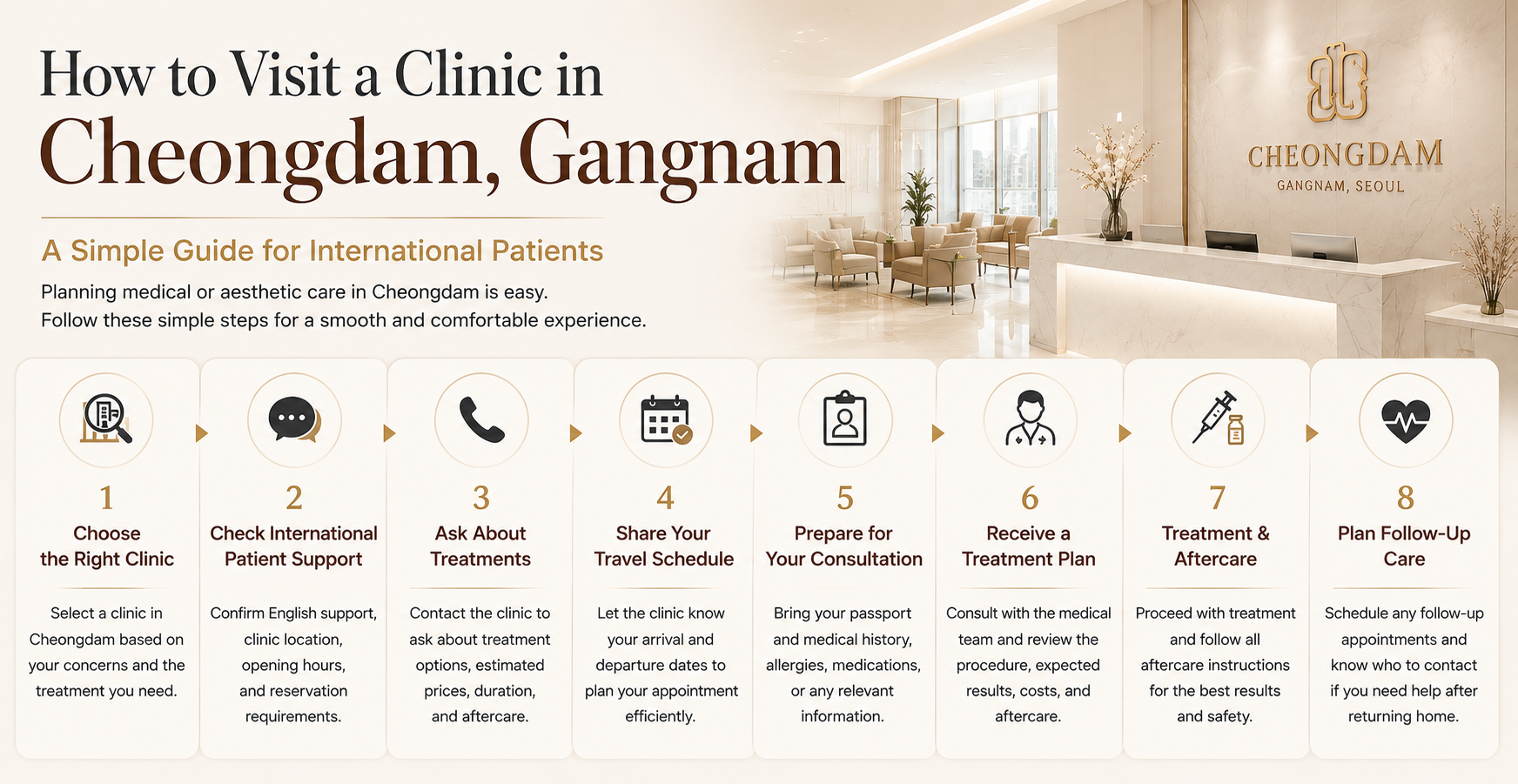
Facelift Surgery in Cheongdam for Foreigners
International patients need to plan beyond the operation itself.
Before traveling to Seoul, consider arranging:
- A preoperative consultation
- Medical history and medication information
- Appropriate laboratory or medical tests if requested
- Professional interpretation when necessary
- Written surgical consent documents you understand
- Accommodation close enough to attend follow-up visits
- Airport and local transportation
- A postoperative contact person
- A plan for unexpected complications
South Korea provides medical-tourism visa pathways, including short-term C-3-3 visas for eligible medical visitors whose treatment and travel period is generally 90 days or less; requirements depend on the individual's circumstances.
Patients should verify current immigration and medical-tourism requirements before making travel arrangements.
Most importantly, do not schedule a flight home based solely on a standard recovery estimate. Your surgeon should advise you about postoperative review and whether you are medically ready to travel.
How Much Does Facelift Surgery in Cheongdam Cost?
There is no single standard price for facelift surgery in Cheongdam.
The total cost can depend on:
- Type of facelift
- Surgical technique
- Extent of facial or neck correction
- Surgeon and facility
- Anesthesia
- Preoperative testing
- Postoperative care
- Additional procedures
- Complexity of the case
- Revision requirements
International patients should also budget for accommodation, transportation, flights, interpretation if needed, medications, and a possible extension of their stay.
Instead of comparing headline prices alone, request a detailed quotation explaining what is included. Confirm whether consultations, anesthesia, facility charges, medications, follow-up appointments, and postoperative treatment are included.
Questions to Ask Before Facelift Surgery
Before choosing a facelift surgeon in Cheongdam, consider asking:
- Who will perform the surgery?
- What type of facelift do you recommend for my anatomy?
- Why is this technique appropriate for me?
- Will the procedure include the neck?
- Will the SMAS or deeper tissue layers be addressed?
- What type of anesthesia will be used?
- What are my individual risks?
- Where will the surgery take place?
- How long should I stay in Seoul?
- When will my follow-up appointments occur?
- When can I fly home?
- What happens if I develop a complication after returning home?
- What is included in the total cost?
- How are revision procedures handled?
A consultation should provide realistic information about both the potential improvement and the limitations of surgery.
Conclusion
Facelift surgery in Cheongdam can be an option for patients seeking a surgical approach to significant facial laxity, jowling, lower-face aging, or selected neck-aging concerns. Modern facelift surgery includes several techniques, and the appropriate approach depends on individual anatomy rather than the popularity of a particular procedure.
For international patients, the decision should include not only the surgeon and technique but also anesthesia, facility standards, communication, recovery time, follow-up, travel planning, and emergency arrangements.
Cheongdam's location can make it convenient for patients exploring cosmetic surgery in Seoul, but the neighborhood itself is not a substitute for careful medical evaluation. The most appropriate facelift is the one that matches the patient's anatomy, goals, risk profile, and willingness to undergo surgery and recovery.
FAQs About Facelift Surgery in Cheongdam
Is facelift surgery available for international patients in Cheongdam?
International patients can seek plastic surgery in Seoul, including facelift procedures. Before booking, confirm the clinic's language support, consultation process, consent documentation, postoperative care, and arrangements for complications.
What areas can a facelift improve?
A facelift can address certain forms of facial skin laxity, jowling, lower-face aging, and soft-tissue descent. Depending on the procedure, the neck and selected midface areas may also be addressed.
What is the difference between a SMAS and deep-plane facelift?
Both techniques work with deeper facial supporting structures, but they involve different tissue planes and surgical approaches. Current evidence suggests both can provide good outcomes, while available comparative research does not establish one technique as universally superior.
Is a facelift better than non-surgical lifting?
Not necessarily. A facelift is more invasive but can address more substantial tissue laxity. Non-surgical treatments may be appropriate for patients with milder concerns or those who prefer to avoid surgery.
How long does facelift recovery take?
Recovery varies according to the extent of surgery and the individual. Swelling and bruising are common during the early recovery period, while the final appearance develops progressively as tissues heal. Your surgeon should provide personalized activity and travel guidance.
What are the risks of facelift surgery?
Potential risks include bleeding, infection, hematoma, fluid accumulation, altered sensation, poor wound healing, scarring, asymmetry, prolonged swelling, and facial nerve weakness. Serious complications are uncommon but should be discussed before surgery.
Can a facelift remove all signs of aging?
No. A facelift primarily addresses certain forms of tissue laxity and descent. It does not stop future aging and may not correct pigmentation, skin texture, every fine line, or volume loss.
How long should foreigners stay in Seoul after a facelift?
There is no universal timeframe. The required stay depends on the procedure, healing, and the surgeon's follow-up protocol. International patients should arrange postoperative assessment before booking a return flight.