Cheongdam Medical Tourism Guide
Cheongdam Medical Tourism Guide
Cheongdam medical tourism has become an important part of Seoul's international healthcare landscape, particularly for visitors interested in dermatology, aesthetic medicine, plastic surgery, and other specialized treatments.
Located in Gangnam-gu, Seoul, Cheongdam is surrounded by well-known areas such as Apgujeong, Apgujeong Rodeo, and Dosan-daero. The area has a concentration of medical and aesthetic providers, including institutions registered with Korea's official medical-tourism system. Medical Korea's current registry includes multiple clinics in and around Cheongdam, including providers with dedicated international healthcare contact information.
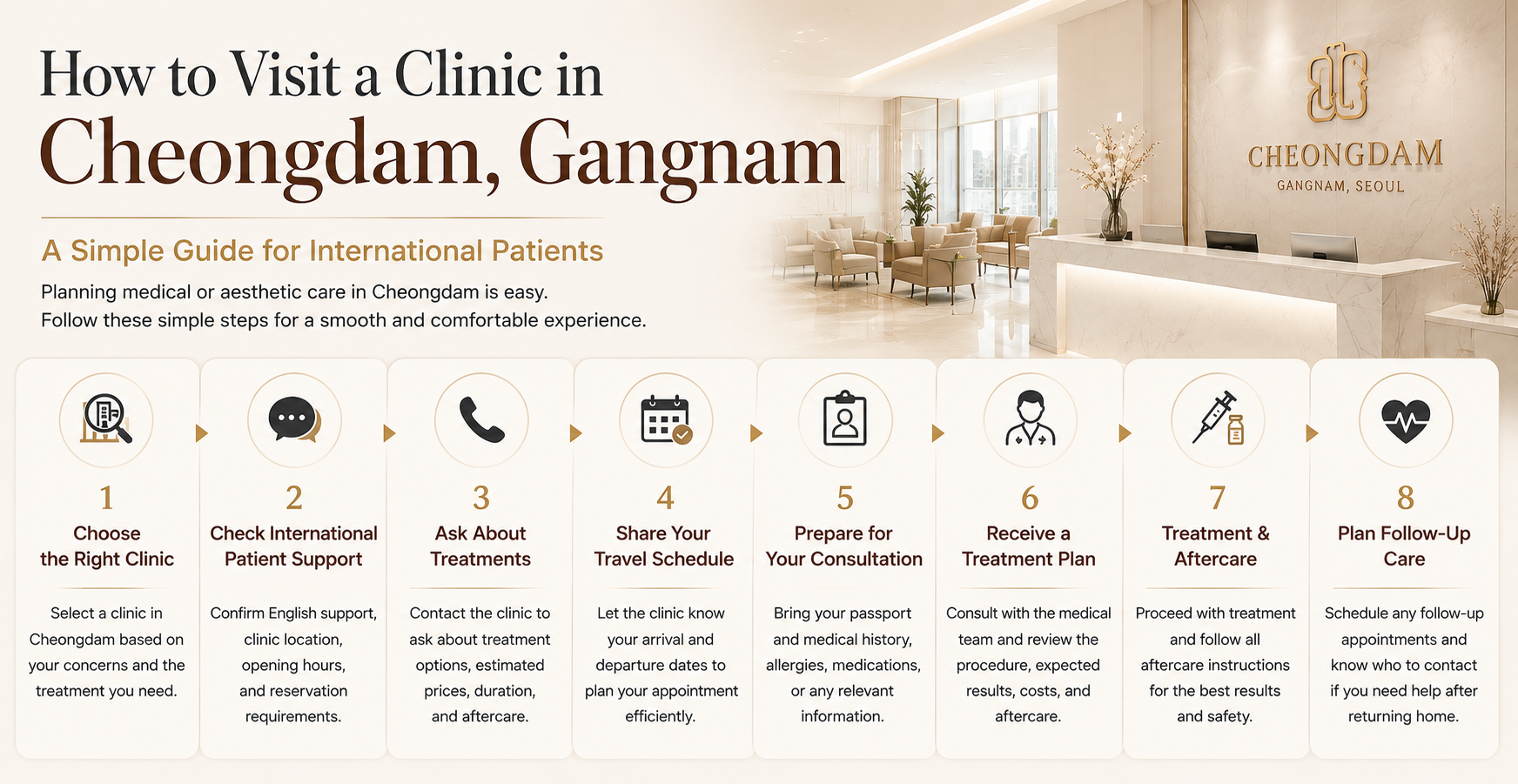
For international visitors, however, medical tourism involves more than choosing a clinic. Planning should include provider selection, consultation, communication, treatment timing, accommodation, transportation, recovery, follow-up care, and the journey home.
What Is Medical Tourism in Cheongdam?
Medical tourism generally refers to traveling to another country to receive medical treatment while combining the healthcare experience with travel or other activities.
In Cheongdam, international patients may seek treatments ranging from cosmetic dermatology and skin procedures to plastic surgery. Depending on the provider, international-patient services can include multilingual consultation, interpretation, reservations, transportation assistance, and other forms of coordination.
Korea's Medical Korea system maintains information on registered medical institutions and foreign-patient services. The registration system exists to establish requirements for institutions and businesses that attract international patients.
This makes checking a provider's registration and international-patient arrangements an important part of planning.
Why Do International Patients Choose Cheongdam?
Cheongdam is particularly relevant to visitors interested in aesthetic and cosmetic treatments because the surrounding Gangnam area has a large concentration of specialized clinics.
Medical Korea's listings show Cheongdam-area providers across specialties including dermatology and plastic surgery, with some institutions offering international healthcare centers and interpretation services.
Potential advantages for international patients include:
- Concentration of aesthetic medical providers
- Access to dermatology and plastic surgery services
- International-patient coordination at some institutions
- Multilingual assistance at selected providers
- Convenient access to other parts of Seoul
- Ability to combine medical appointments with a Seoul trip
However, these advantages do not mean every clinic is suitable for every patient. Provider selection should always be based on the specific treatment, medical qualifications, safety arrangements, and follow-up plan.
Common Treatments for Medical Tourists in Cheongdam
The appropriate treatment depends on the patient's medical or aesthetic concern.
Dermatology and Skin Treatments
International visitors may research treatments for acne, pigmentation, melasma, acne scars, enlarged pores, skin texture, redness, or signs of aging.
Depending on the diagnosis and treatment plan, options may include laser procedures, energy-based treatments, injectables, chemical peels, or other dermatological approaches.
Not every skin treatment is appropriate for every skin type, and consultation is important before selecting a procedure.
Cosmetic Dermatology and Aesthetic Medicine
Aesthetic clinics may offer procedures intended to improve skin quality, facial volume, wrinkles, or skin laxity.
Examples can include:
- Botox
- Dermal fillers
- Skin boosters
- Rejuvenation treatments
- Laser treatments
- Energy-based lifting
- Regenerative or injectable treatments
Patients should understand what each procedure is designed to address rather than choosing treatment solely because it is popular.
Plastic Surgery
Cheongdam and the wider Gangnam area also have plastic surgery providers offering procedures such as rhinoplasty, eyelid surgery, facial contouring, lifting procedures, and other operations.
Medical Korea's listings include Cheongdam plastic surgery institutions with international-patient support and multilingual coordinators.
Surgical tourism requires more planning than a short outpatient aesthetic appointment because anesthesia, recovery, postoperative monitoring, and follow-up need to be considered.
How to Choose a Cheongdam Clinic
Choosing a provider is one of the most important parts of medical tourism.
Rather than selecting a clinic based only on social media, promotional pricing, or before-and-after photographs, investigate several practical factors.
Check Registration
For foreign patients, checking whether the medical institution is registered within Korea's international-patient system can be a useful starting point.
Medical Korea maintains a registered-hospital database and identifies institutions that provide international healthcare services. Its current database includes numerous Cheongdam-area clinics.
Registration does not mean a clinic is automatically the right choice for a particular procedure, but it provides an important verification point.
Research the Medical Provider
Look at the provider's specialty, the procedures they actually perform, the qualifications of the medical professional who will treat you, and the type of facility where treatment takes place.
For surgery, find out who will personally perform the procedure rather than assuming that a consultation with one person means that person will conduct the operation.
Evaluate Communication
Clear communication is particularly important when discussing medical procedures.
Ask whether English or another language is supported and whether professional interpretation is available for consultation and postoperative instructions.
Some Cheongdam-area institutions listed by Medical Korea provide multilingual services, but the languages and scope of support differ between providers.
Planning Your Medical Tourism Trip
Medical travel should be planned around the treatment rather than treating the procedure as a small addition to an ordinary vacation.
Before booking flights, establish:
- Consultation date
- Treatment date
- Expected recovery period
- Follow-up schedule
- Recommended length of stay
- Activity restrictions
- Medication requirements
- Return-flight timing
For surgery, scheduling the procedure immediately before a flight home can be inappropriate because postoperative assessment may still be necessary.
Non-surgical treatments may require less downtime, but some can still cause redness, swelling, bruising, peeling, or temporary sensitivity.
Medical Records and Consultation
Before traveling, prepare relevant medical information.
This may include:
- Current medications
- Allergies
- Previous surgeries
- Previous cosmetic treatments
- Relevant medical conditions
- Previous complications
- Recent test results when applicable
If you are considering revision surgery, previous operative records can be particularly valuable.
An online consultation may help with preliminary planning, but it should not automatically replace an in-person examination when one is medically necessary.
Language Support for Foreign Patients
Language support can make a significant difference in medical tourism.
Medical terminology is not always easy to communicate through casual translation, especially when discussing anesthesia, medication, complications, surgical limitations, and postoperative instructions.
Some registered providers have international healthcare centers or interpretation services. For example, Medical Korea's current provider listings identify clinics with multilingual interpretation and international-patient coordination.
Before traveling, confirm exactly what language services are available and whether they cover the entire treatment process or only the initial consultation.
Accommodation and Transportation
Accommodation should be selected based on the treatment and recovery requirements.
For a minimally invasive procedure, a standard hotel may be adequate. After major surgery, however, patients may prefer accommodation that minimizes stairs, long walks, and complicated transportation.
Transportation arrangements can also be important after procedures involving anesthesia or significant swelling.
Some medical institutions offer transportation or airport-related assistance for international patients, but these services vary. Medical Korea's provider listings specifically identify institutions that offer services such as airport pickup or transportation support.
Recovery During a Seoul Trip
One of the biggest mistakes in medical tourism planning is underestimating recovery.
After surgery, swelling, bruising, discomfort, restricted activity, and scheduled follow-up may affect your ability to sightsee.
Even after non-surgical treatments, the skin may temporarily appear red or swollen.
Patients should therefore create two schedules:
Medical schedule: consultation, procedure, recovery, follow-up.
Travel schedule: sightseeing, shopping, dining, transportation, and other activities.
The medical schedule should take priority.
Seoul Medical Tour Support
International visitors can also access broader medical-tourism support in Seoul.
The official Seoul Medical Tour Help Desk provides information about medical institutions and medical-tourism services and offers support that can include interpretation and airport pickup/drop-off services. It also describes one-stop consultation covering the process from arrival through medical visits and departure.
This can be useful for visitors who need general guidance about navigating healthcare services in Seoul.
Understanding Costs
Medical tourism costs extend beyond the treatment price.
A realistic budget may include:
- Consultation
- Procedure or surgery
- Anesthesia
- Medical testing
- Medication
- Follow-up care
- Interpretation
- Accommodation
- Flights
- Airport transportation
- Local transportation
- Additional nights in Seoul
- Recovery-related expenses
Prices can also vary considerably between providers and treatment plans.
Patients should request a written quotation and ask what is included before paying a deposit.
Do not assume that a promotional price represents the total medical expense.
Tax Refunds and International-Patient Services
Eligible foreign visitors may have access to Korea's medical-service tax refund system under applicable rules.
Because eligibility, participating institutions, documentation requirements, and regulations can change, patients should confirm current information directly with the provider and relevant Korean authorities before including a potential refund in their budget.
International-patient services can also vary considerably. Some providers offer interpretation, transportation, reservations, or dedicated coordinators, while others may provide only basic assistance.
Safety and Emergency Planning
Safety planning should be part of every medical tourism trip.
Before treatment, know:
- Where the procedure will take place
- Who to contact after treatment
- Where follow-up will occur
- What symptoms require urgent medical attention
- How to reach emergency medical services
- What happens if a complication develops after returning home
Korea's international-patient framework includes registration requirements for institutions attracting foreign patients, including professional staffing and medical-liability insurance requirements under the applicable system.
Patients should still ask individual providers about their specific safety and emergency arrangements.
Questions to Ask Before Booking
Before committing to treatment in Cheongdam, consider asking:
- Is the medical institution registered for international patients?
- Who will perform my treatment?
- What qualifications are relevant to this procedure?
- What treatment is actually being recommended?
- Are there alternatives?
- What are the risks and possible side effects?
- How much downtime should I expect?
- How many follow-up appointments are needed?
- Is interpretation available?
- What does the quoted price include?
- Are medication and testing included?
- How long should I remain in Seoul?
- When is it appropriate to fly home?
- Who should I contact if a complication occurs?
Getting clear answers before traveling can prevent many avoidable misunderstandings.
Medical Tourism in Cheongdam vs a Regular Seoul Vacation
A normal vacation is generally planned around sightseeing, dining, shopping, and entertainment.
A medical-tourism trip needs a different structure.
The procedure may determine when you can walk long distances, visit attractions, consume alcohol, exercise, use saunas, or spend time outdoors. Depending on the treatment, certain activities may need to be postponed.
For this reason, patients should avoid filling every day of the trip with activities.
Leaving flexible time before and after treatment can make the trip considerably easier.
Conclusion
A Cheongdam medical tourism trip can combine access to Seoul's aesthetic and healthcare services with the experience of visiting one of the city's best-known districts.
But successful medical travel requires more than finding a clinic and booking a flight. International patients should verify the provider, understand the recommended treatment, prepare medical records, confirm language support, calculate the complete cost, arrange suitable accommodation, and allow enough time for recovery and follow-up.
Cheongdam can be a useful location for patients researching dermatology, aesthetic medicine, and plastic surgery in Seoul, but treatment decisions should remain based on medical suitability, provider qualifications, safety, communication, and realistic expectations.
FAQs About Cheongdam Medical Tourism
What is Cheongdam medical tourism?
Cheongdam medical tourism refers to international visitors traveling to the Cheongdam area of Seoul for medical, dermatological, aesthetic, or plastic surgery services.
Is Cheongdam suitable for foreign medical tourists?
Cheongdam has multiple medical providers registered in Korea's international-patient system, and some offer multilingual services or international healthcare centers.
What treatments do medical tourists seek in Cheongdam?
Common interests include dermatology, laser treatments, aesthetic medicine, injectables, skin rejuvenation, rhinoplasty, eyelid surgery, facial contouring, lifting procedures, and body contouring.
Do Cheongdam clinics provide English-speaking staff?
Some providers offer English or multilingual support, but services vary. Patients should confirm language availability directly before booking.
How long should I stay in Seoul after plastic surgery?
There is no universal stay length. It depends on the procedure, recovery, follow-up schedule, and individual circumstances. The surgeon should provide guidance before the return flight is booked.
Can I combine medical treatment with sightseeing?
Sometimes, particularly with treatments involving little downtime. However, surgery and some dermatological procedures can temporarily restrict activity, so sightseeing should be planned around recovery.
Should I check whether a clinic is registered for international patients?
Yes. Medical Korea maintains a registered medical institution database, making registration an important verification point for foreign patients.
What should I bring to a medical appointment in Cheongdam?
Bring your passport or required identification for registration, medication information, allergy details, relevant medical records, previous procedure information, and a list of questions. Do not provide unnecessary sensitive documents unless the medical provider specifically requires them.
Where can foreign visitors get general medical-tourism assistance in Seoul?
The official Seoul Medical Tour Help Desk provides information and support for foreign medical tourists, including medical institution information, interpretation-related assistance, and other services.